Maria Montessori: The Doctor Who Let Children Learn by Doing
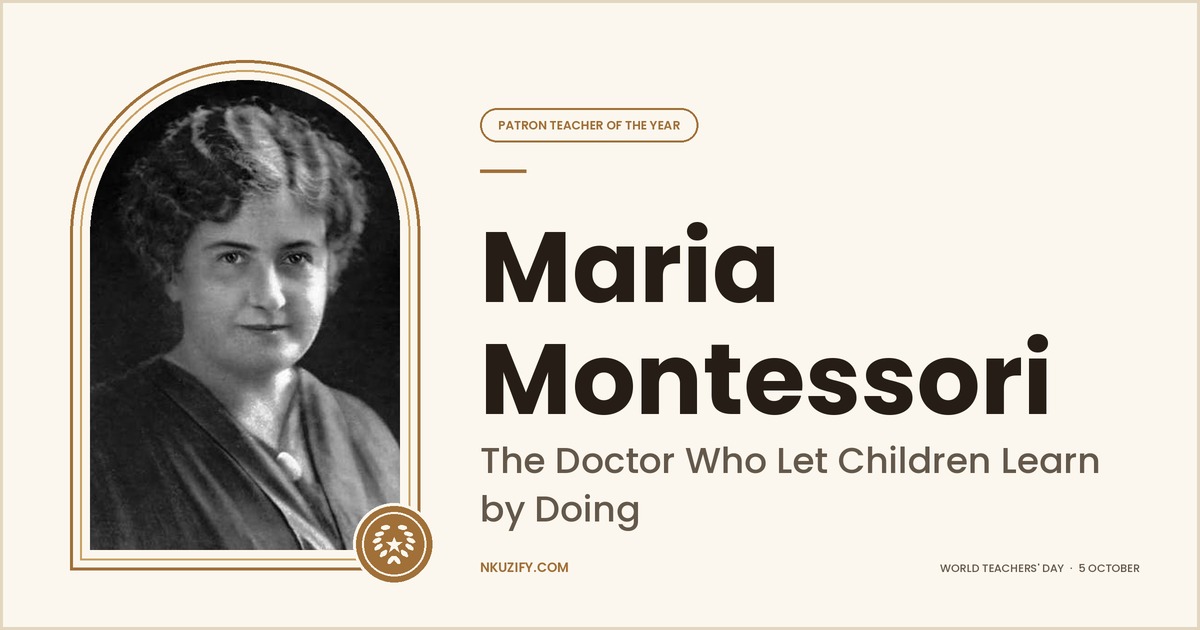
Recognised by Nkuzify as Patron Teacher of the Year.
World Teachers' Day
Happy Teachers' Day from all of us at Nkuzify.
On 6 January 1907, in a block of flats in the San Lorenzo quarter of Rome, a doctor opened the door to a room of small children from poor working families.
She had not trained as a teacher. She had trained as a doctor, and for years she had worked with children whom others had written off. She brought with her the materials she had developed for them.
Soon the five-year-olds in that room were reading and writing. The doctor was Maria Montessori.
A girl who was told no
She was born on 31 August 1870 in Chiaravalle, Italy, the only child of an army officer and his wife. Her father discouraged any professional career for his daughter, but her mother encouraged her, and she began to attend a boys' technical school in Rome.
She set her heart on medicine. She was refused at first and then admitted to the University of Rome in 1890, where she faced prejudice from her male classmates. She qualified as a doctor on 10 July 1896, one of the first women in Italy to do so.
From patients to pupils
She went to work at the psychiatric clinic of the University of Rome, where she became interested in children with intellectual disabilities, and became co-director of the Orthophrenic School. In 1897 and 1898 she studied the ideas of Rousseau, Pestalozzi and Froebel, and from 1900 to 1907 she lectured on teaching at the university.
The Children's House
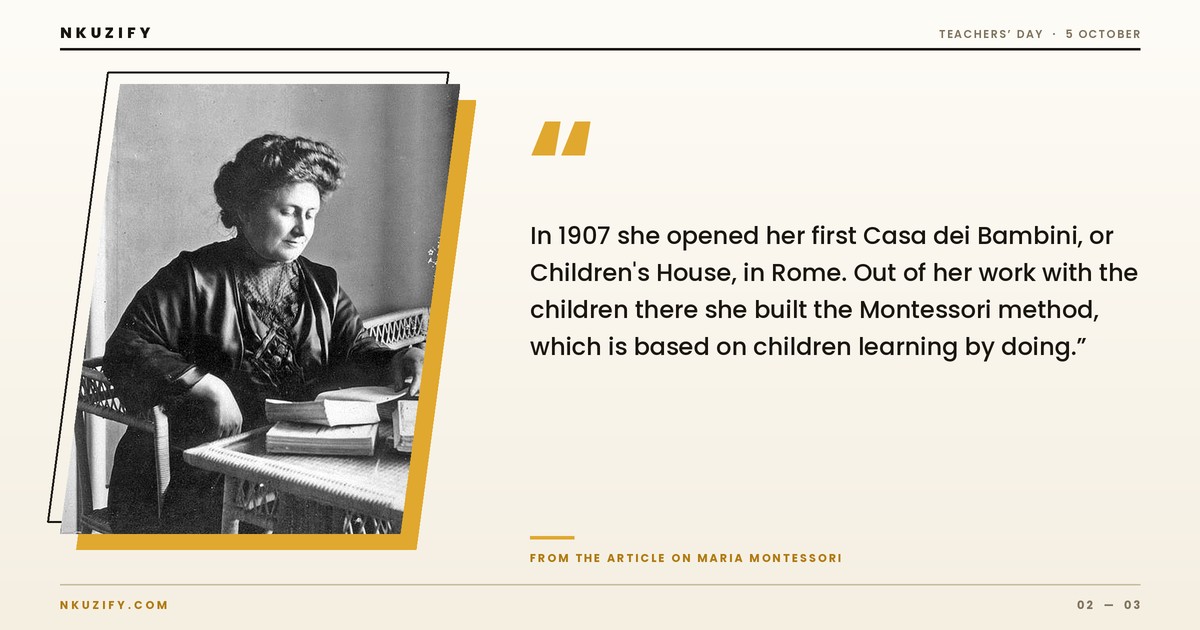
The San Lorenzo flats had been repaired for poor working families, and the young children were left to run about while their parents worked. She opened her first Casa dei Bambini, or Children's House, there on 6 January 1907, with materials she had developed at the Orthophrenic School. What she saw taught her that children build their own knowledge, and that education is not only a matter of handing it over.
By the autumn of 1908 there were five Children's Houses, four in Rome and one in Milan. In San Francisco, visitors watched a Montessori class work behind a glass wall for four months.
A method that crossed the world
In 1909 she gave her first training course to around 100 students, and her first book appeared. It reached the United States in 1912 as The Montessori Method and was later translated into 20 languages. She founded the Association Montessori Internationale in 1929 to protect her work.
By 1933 the Nazis had closed the Montessori schools in Germany, and Mussolini did the same in Italy. She lived in exile and settled in the Netherlands, where she died on 6 May 1952, aged 81. She was the first early childhood educator to be nominated for the Nobel Peace Prize.
Why Nkuzify celebrates her
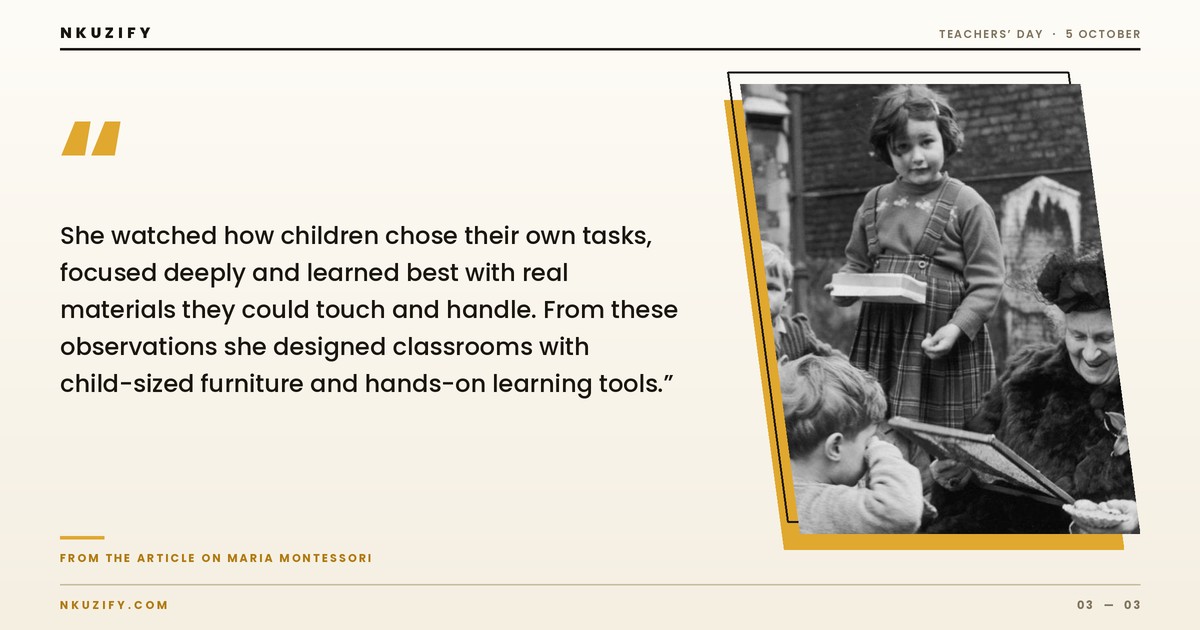
Montessori watched children before she taught them. Her classrooms put real objects into small hands and let each child work at their own pace. At Nkuzify we believe learning that a student can touch and try stays longer than learning that is only heard. She also reminds us that the children others overlook often show us how learning really works.
Read more in Global Patrons of Teaching, or make a free Thank You card for your own teacher.
Comments (0)