What Botpress does best

Martins Aligwe
August 19, 2026
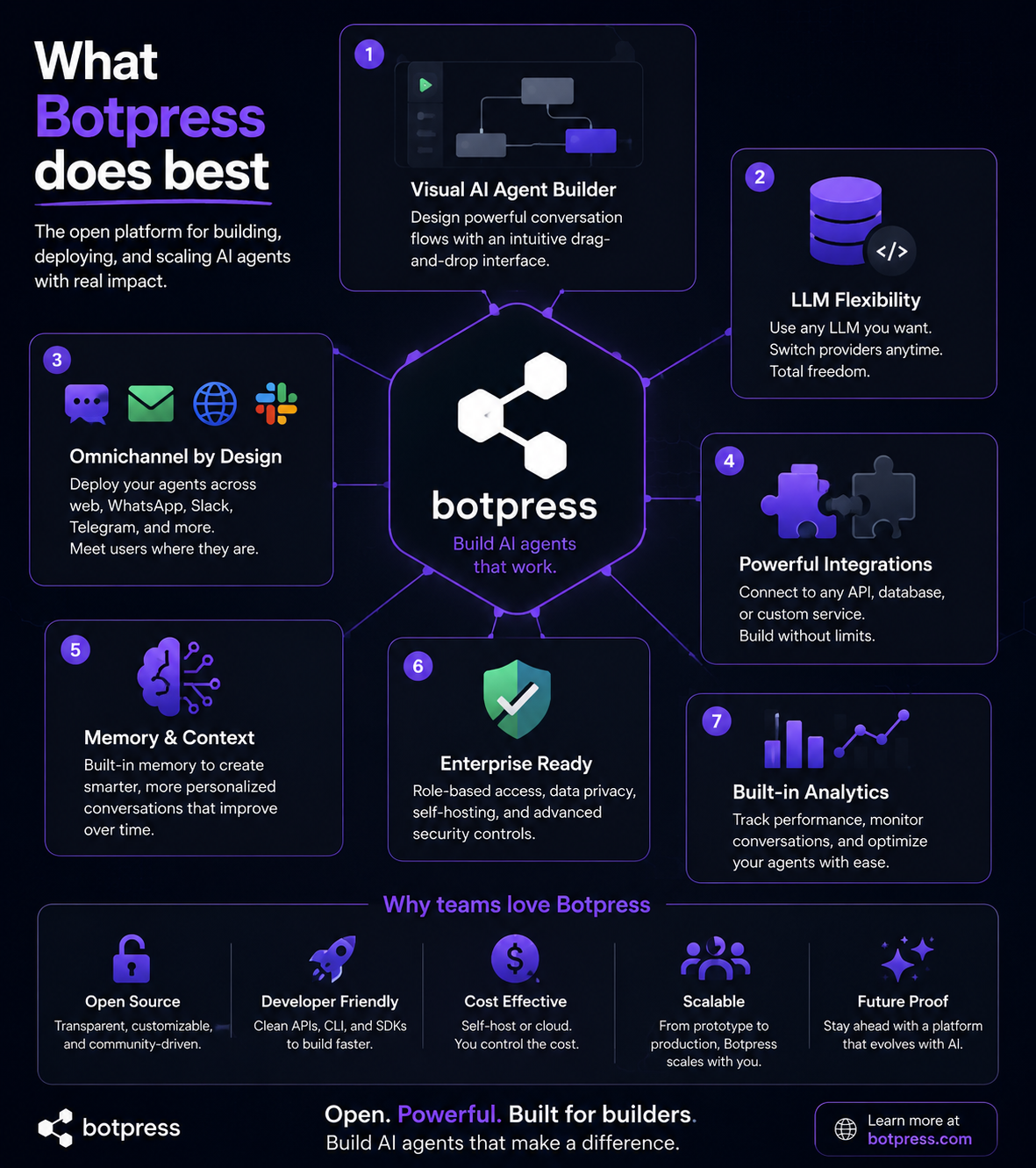
In today’s digital world, businesses, schools, organizations, and developers are increasingly looking for better ways to communicate with people online. Customers expect quick answers, useful information, and support at any time of the day. This is where artificial intelligence has become extremely important. One platform designed to make the creation of AI-powered agents easier is Botpress. Botpress is an all-in-one platform for building, testing, deploying, and managing AI agents, with tools designed to support both visual builders and developers.
1. Building AI Agents Visually
One of the things Botpress does especially well is making AI-agent development more accessible through a visual development environment. Instead of requiring a developer to write every part of an application from scratch, Botpress Studio provides a visual, drag-and-drop environment where users can design workflows, configure nodes, add actions, and manage how their AI agent behaves.
This is valuable because creating an AI agent can otherwise involve many different technologies. A developer may need to think about language models, databases, APIs, conversations, user interfaces, deployment, and monitoring. Botpress brings many of these pieces together in one environment.
For beginners, this visual approach can make the concepts behind AI agents easier to understand. For experienced developers, it provides a faster way to design and test conversational systems before adding more advanced customization.
2. Creating Intelligent Conversations
Botpress is not simply about creating a chatbot that responds to keywords. Its tools are designed for creating AI agents that can understand user requests and perform useful tasks.
A Botpress agent can be given instructions, knowledge, tools, and workflows that determine how it should respond. Its agent system also includes specialized capabilities for areas such as personality, policies, translation, knowledge retrieval, analytics, vision, and human intervention.
This means that businesses can design agents with a particular role and behavior. For example, a company could create an AI customer-service agent that answers questions about products, explains company policies, retrieves information from a knowledge base, and transfers complicated conversations to a human representative.
The goal is not simply to make the bot talk. The goal is to make the bot useful.
3. Giving AI Agents Business Knowledge
Another major strength of Botpress is its Knowledge Base functionality. An AI agent becomes much more useful when it can access information that is specific to the organization using it.
Botpress allows knowledge sources such as documents, websites, files, tables, and other forms of information to be connected to an agent. The agent can then use those sources when answering questions.
Imagine a school creating an AI assistant. Instead of giving generic answers, the school could provide information about courses, admission requirements, school rules, schedules, and frequently asked questions. Students could then ask the assistant questions and receive answers based on the school's own information.
A business could use a similar system for product manuals, policies, FAQs, pricing information, or support documentation.
Botpress also provides tools for improving knowledge retrieval. Its Knowledge Base Optimizer, for example, can analyze documents and generate summaries intended to help the system find more relevant information when responding to questions.
4. Connecting AI to Other Services
AI becomes much more powerful when it can interact with other software. Botpress does this through integrations.
Its integration system allows agents to connect with external services, APIs, tools, and communication channels. These integrations can allow a bot to retrieve information, trigger actions, communicate with external systems, or operate through different messaging platforms.
For example, an AI agent could be connected to WhatsApp so customers can communicate with it through a familiar messaging application. Botpress documentation also describes integrations for platforms and services such as Telegram, Slack, Gmail, Linear, Stripe, and other external systems.
This is one of Botpress's most important strengths because an AI agent becomes much more valuable when it can do things, rather than simply answer questions.
For example, instead of saying, "I can help you with your order," an appropriately configured agent could potentially retrieve order information from another system and provide the relevant information to the customer.
5. Supporting Multiple Communication Channels
People communicate through different platforms. Some customers prefer websites, while others prefer messaging applications.
Botpress is designed to allow AI agents to be deployed across different communication channels. Its documentation identifies channels and integrations including Webchat, Slack, WhatsApp, and Telegram.
This gives organizations the opportunity to build one AI experience and make it available where their customers already spend their time.
For example, a company could have an AI assistant available on its website while also connecting the assistant to WhatsApp. Instead of forcing customers to learn a completely new system, the business can meet them on familiar platforms.
This concept can be described as omnichannel communication: allowing customers to interact with an organization through multiple channels while maintaining a consistent AI-powered experience.
6. Giving Developers Freedom
Although Botpress provides visual tools, it is not limited to people who prefer drag-and-drop development.
Botpress also provides developer tools, APIs, an SDK, and a code-based approach for users who need more control. Its SDK supports components such as integrations, interfaces, bots, and plugins. Developers can also create bots using code rather than only through the visual Studio interface.
This makes Botpress useful for different levels of technical experience.
A beginner might start by creating an agent visually. As the project becomes more complicated, a developer can introduce code, APIs, custom integrations, and other advanced functionality.
This combination of visual development and programming flexibility is one of the platform's strongest characteristics.
7. Working With Different AI Models
Modern AI is developing extremely quickly, and organizations may not want their entire system permanently dependent on one particular language model.
Botpress is designed around AI-agent development rather than simply being a single language model. This allows developers to build applications around large language models while configuring the rest of the agent's behavior, knowledge, workflows, tools, and integrations.
This separation is important because the language model is only one component of an AI agent. A useful production agent also needs instructions, knowledge, actions, integrations, safety policies, monitoring, and a way to communicate with users.
In other words, Botpress focuses on helping people build the complete AI agent system, rather than merely providing access to an AI model.
8. Connecting AI to APIs and Business Systems
Another area where Botpress can be particularly powerful is connecting AI agents to external APIs.
An API allows different software systems to communicate with each other. With integrations, Botpress agents can interact with external services and perform actions based on information received from those services.
This opens up many possibilities.
For example, an online store could create an AI assistant that helps customers find products. The agent could potentially connect to the store's systems, retrieve relevant information, and provide personalized assistance.
A booking company could create an assistant that helps users understand available services. A school could connect an agent to information systems. A service business could build an assistant that collects customer information before sending the conversation to a human employee.
The important idea is that Botpress can serve as a bridge between AI and existing software systems.
9. Memory and Personalization
Good conversations often require context. If a customer explains something at the beginning of a conversation, they should not necessarily have to repeat it every few messages.
Botpress provides tools for storing information and working with conversation context. Its platform includes variables, tables, knowledge bases, and other mechanisms for managing information used by agents.
This can make conversations feel more natural and useful.
For example, an AI assistant helping a customer could use information already provided during the conversation rather than repeatedly asking the same questions. When designed properly, this can create a more personalized experience.
However, personalization should always be implemented responsibly, especially when dealing with sensitive customer information.
10. Analytics and Improving AI Agents
Creating an AI agent is only the beginning. Organizations also need to understand whether the agent is actually helping users.
Botpress provides conversation analysis and analytics capabilities. Its Studio documentation describes conversation analysis that can include sentiment analysis, conversation-topic summaries, and information about whether users' questions were resolved.
This is important because developers need to know what is working and what is failing.
Suppose an AI assistant receives 1,000 customer conversations. Analytics can help the team identify common questions, difficult conversations, unresolved issues, and areas where the agent needs improvement.
Botpress also provides APIs for accessing bot logs, issues, and analytics, allowing organizations and developers to work with their bot data programmatically.
This creates a cycle:
Build → Test → Deploy → Measure → Improve → Repeat.
That cycle is essential for building a reliable AI system.
11. Human Support When AI Is Not Enough
A good AI system should not pretend that it can solve every problem.
Some customer situations require human judgment. Botpress supports human-in-the-loop functionality, allowing AI systems to work alongside human agents. Its platform includes HITL capabilities designed to allow conversations to be transferred to human support when necessary.
This creates a powerful combination.
AI can handle repetitive questions and common requests, while human employees can focus on situations requiring empathy, judgment, or specialized decision-making.
This is particularly important for customer-service organizations because the purpose of AI should not always be to replace humans. In many situations, the better approach is to allow AI and humans to work together.
12. Helping Businesses Scale
Another thing Botpress does well is bringing many components of AI-agent development into a single platform.
Without a platform like this, a team might need to combine a language-model provider, a database, a web application, messaging integrations, analytics software, hosting infrastructure, authentication systems, and custom code.
Botpress aims to simplify this process by providing a unified environment for building, testing, and deploying AI agents. Its documentation describes Botpress as handling the bot-development process from building through deployment, with infrastructure managed in the cloud.
This can be particularly useful for teams that want to move from an idea to a working AI agent without building every piece of infrastructure themselves.
13. Useful for Developers and Beginners
One of Botpress's biggest advantages is its attempt to serve different types of builders.
A person with limited programming experience can begin with the visual interface. A more experienced developer can use APIs, integrations, the SDK, and code-based development for greater flexibility. Botpress itself recommends Studio for most use cases while providing code-based options for developers who need tighter integration with version control or additional customization.
This makes Botpress suitable for learning as well as professional development.
For someone beginning to explore artificial intelligence, Botpress can provide an introduction to important concepts such as workflows, nodes, actions, knowledge bases, APIs, integrations, variables, and AI agents.
For experienced developers, those same concepts can become building blocks for more sophisticated applications.
14. The Bigger Picture
The biggest strength of Botpress is not necessarily one individual feature. Its strength comes from putting many important parts of AI-agent development together.
An AI agent needs more than a language model.
It needs knowledge so it can provide useful information.
It needs instructions so it understands its role.
It needs workflows so developers can control important processes.
It needs tools and integrations so it can interact with other systems.
It needs channels so users can communicate with it.
It needs analytics so developers can understand performance.
It may need human support when AI cannot safely or effectively handle a situation.
Botpress brings these concepts together into an environment designed specifically for building AI agents.
Conclusion
Botpress does its best work when it is used as a platform for turning AI from a simple conversation tool into a practical digital agent. Its strongest capabilities include visual AI-agent development, knowledge bases, integrations, multiple communication channels, APIs, developer tools, analytics, personalization, and human-in-the-loop support.
The most important idea is that Botpress is not simply about making a chatbot that can talk. It is about building an AI system that can understand, access information, use tools, interact with other software, communicate with users, and perform useful tasks.
For businesses, this can mean faster customer support and more efficient digital services. For developers, it can mean a more structured environment for building AI applications. For beginners, it can provide a visual way to understand how modern AI agents are created.
As artificial intelligence continues to become a bigger part of websites, businesses, applications, and customer service, platforms such as Botpress are helping make AI-agent development more accessible. Its central value is the ability to bring the different pieces required to build useful AI agents into one development environment—helping builders move from an idea to an AI agent that can actually work in the real world.
1. Building AI Agents Visually
One of the things Botpress does especially well is making AI-agent development more accessible through a visual development environment. Instead of requiring a developer to write every part of an application from scratch, Botpress Studio provides a visual, drag-and-drop environment where users can design workflows, configure nodes, add actions, and manage how their AI agent behaves.
This is valuable because creating an AI agent can otherwise involve many different technologies. A developer may need to think about language models, databases, APIs, conversations, user interfaces, deployment, and monitoring. Botpress brings many of these pieces together in one environment.
For beginners, this visual approach can make the concepts behind AI agents easier to understand. For experienced developers, it provides a faster way to design and test conversational systems before adding more advanced customization.
2. Creating Intelligent Conversations
Botpress is not simply about creating a chatbot that responds to keywords. Its tools are designed for creating AI agents that can understand user requests and perform useful tasks.
A Botpress agent can be given instructions, knowledge, tools, and workflows that determine how it should respond. Its agent system also includes specialized capabilities for areas such as personality, policies, translation, knowledge retrieval, analytics, vision, and human intervention.
This means that businesses can design agents with a particular role and behavior. For example, a company could create an AI customer-service agent that answers questions about products, explains company policies, retrieves information from a knowledge base, and transfers complicated conversations to a human representative.
The goal is not simply to make the bot talk. The goal is to make the bot useful.
3. Giving AI Agents Business Knowledge
Another major strength of Botpress is its Knowledge Base functionality. An AI agent becomes much more useful when it can access information that is specific to the organization using it.
Botpress allows knowledge sources such as documents, websites, files, tables, and other forms of information to be connected to an agent. The agent can then use those sources when answering questions.
Imagine a school creating an AI assistant. Instead of giving generic answers, the school could provide information about courses, admission requirements, school rules, schedules, and frequently asked questions. Students could then ask the assistant questions and receive answers based on the school's own information.
A business could use a similar system for product manuals, policies, FAQs, pricing information, or support documentation.
Botpress also provides tools for improving knowledge retrieval. Its Knowledge Base Optimizer, for example, can analyze documents and generate summaries intended to help the system find more relevant information when responding to questions.
4. Connecting AI to Other Services
AI becomes much more powerful when it can interact with other software. Botpress does this through integrations.
Its integration system allows agents to connect with external services, APIs, tools, and communication channels. These integrations can allow a bot to retrieve information, trigger actions, communicate with external systems, or operate through different messaging platforms.
For example, an AI agent could be connected to WhatsApp so customers can communicate with it through a familiar messaging application. Botpress documentation also describes integrations for platforms and services such as Telegram, Slack, Gmail, Linear, Stripe, and other external systems.
This is one of Botpress's most important strengths because an AI agent becomes much more valuable when it can do things, rather than simply answer questions.
For example, instead of saying, "I can help you with your order," an appropriately configured agent could potentially retrieve order information from another system and provide the relevant information to the customer.
5. Supporting Multiple Communication Channels
People communicate through different platforms. Some customers prefer websites, while others prefer messaging applications.
Botpress is designed to allow AI agents to be deployed across different communication channels. Its documentation identifies channels and integrations including Webchat, Slack, WhatsApp, and Telegram.
This gives organizations the opportunity to build one AI experience and make it available where their customers already spend their time.
For example, a company could have an AI assistant available on its website while also connecting the assistant to WhatsApp. Instead of forcing customers to learn a completely new system, the business can meet them on familiar platforms.
This concept can be described as omnichannel communication: allowing customers to interact with an organization through multiple channels while maintaining a consistent AI-powered experience.
6. Giving Developers Freedom
Although Botpress provides visual tools, it is not limited to people who prefer drag-and-drop development.
Botpress also provides developer tools, APIs, an SDK, and a code-based approach for users who need more control. Its SDK supports components such as integrations, interfaces, bots, and plugins. Developers can also create bots using code rather than only through the visual Studio interface.
This makes Botpress useful for different levels of technical experience.
A beginner might start by creating an agent visually. As the project becomes more complicated, a developer can introduce code, APIs, custom integrations, and other advanced functionality.
This combination of visual development and programming flexibility is one of the platform's strongest characteristics.
7. Working With Different AI Models
Modern AI is developing extremely quickly, and organizations may not want their entire system permanently dependent on one particular language model.
Botpress is designed around AI-agent development rather than simply being a single language model. This allows developers to build applications around large language models while configuring the rest of the agent's behavior, knowledge, workflows, tools, and integrations.
This separation is important because the language model is only one component of an AI agent. A useful production agent also needs instructions, knowledge, actions, integrations, safety policies, monitoring, and a way to communicate with users.
In other words, Botpress focuses on helping people build the complete AI agent system, rather than merely providing access to an AI model.
8. Connecting AI to APIs and Business Systems
Another area where Botpress can be particularly powerful is connecting AI agents to external APIs.
An API allows different software systems to communicate with each other. With integrations, Botpress agents can interact with external services and perform actions based on information received from those services.
This opens up many possibilities.
For example, an online store could create an AI assistant that helps customers find products. The agent could potentially connect to the store's systems, retrieve relevant information, and provide personalized assistance.
A booking company could create an assistant that helps users understand available services. A school could connect an agent to information systems. A service business could build an assistant that collects customer information before sending the conversation to a human employee.
The important idea is that Botpress can serve as a bridge between AI and existing software systems.
9. Memory and Personalization
Good conversations often require context. If a customer explains something at the beginning of a conversation, they should not necessarily have to repeat it every few messages.
Botpress provides tools for storing information and working with conversation context. Its platform includes variables, tables, knowledge bases, and other mechanisms for managing information used by agents.
This can make conversations feel more natural and useful.
For example, an AI assistant helping a customer could use information already provided during the conversation rather than repeatedly asking the same questions. When designed properly, this can create a more personalized experience.
However, personalization should always be implemented responsibly, especially when dealing with sensitive customer information.
10. Analytics and Improving AI Agents
Creating an AI agent is only the beginning. Organizations also need to understand whether the agent is actually helping users.
Botpress provides conversation analysis and analytics capabilities. Its Studio documentation describes conversation analysis that can include sentiment analysis, conversation-topic summaries, and information about whether users' questions were resolved.
This is important because developers need to know what is working and what is failing.
Suppose an AI assistant receives 1,000 customer conversations. Analytics can help the team identify common questions, difficult conversations, unresolved issues, and areas where the agent needs improvement.
Botpress also provides APIs for accessing bot logs, issues, and analytics, allowing organizations and developers to work with their bot data programmatically.
This creates a cycle:
Build → Test → Deploy → Measure → Improve → Repeat.
That cycle is essential for building a reliable AI system.
11. Human Support When AI Is Not Enough
A good AI system should not pretend that it can solve every problem.
Some customer situations require human judgment. Botpress supports human-in-the-loop functionality, allowing AI systems to work alongside human agents. Its platform includes HITL capabilities designed to allow conversations to be transferred to human support when necessary.
This creates a powerful combination.
AI can handle repetitive questions and common requests, while human employees can focus on situations requiring empathy, judgment, or specialized decision-making.
This is particularly important for customer-service organizations because the purpose of AI should not always be to replace humans. In many situations, the better approach is to allow AI and humans to work together.
12. Helping Businesses Scale
Another thing Botpress does well is bringing many components of AI-agent development into a single platform.
Without a platform like this, a team might need to combine a language-model provider, a database, a web application, messaging integrations, analytics software, hosting infrastructure, authentication systems, and custom code.
Botpress aims to simplify this process by providing a unified environment for building, testing, and deploying AI agents. Its documentation describes Botpress as handling the bot-development process from building through deployment, with infrastructure managed in the cloud.
This can be particularly useful for teams that want to move from an idea to a working AI agent without building every piece of infrastructure themselves.
13. Useful for Developers and Beginners
One of Botpress's biggest advantages is its attempt to serve different types of builders.
A person with limited programming experience can begin with the visual interface. A more experienced developer can use APIs, integrations, the SDK, and code-based development for greater flexibility. Botpress itself recommends Studio for most use cases while providing code-based options for developers who need tighter integration with version control or additional customization.
This makes Botpress suitable for learning as well as professional development.
For someone beginning to explore artificial intelligence, Botpress can provide an introduction to important concepts such as workflows, nodes, actions, knowledge bases, APIs, integrations, variables, and AI agents.
For experienced developers, those same concepts can become building blocks for more sophisticated applications.
14. The Bigger Picture
The biggest strength of Botpress is not necessarily one individual feature. Its strength comes from putting many important parts of AI-agent development together.
An AI agent needs more than a language model.
It needs knowledge so it can provide useful information.
It needs instructions so it understands its role.
It needs workflows so developers can control important processes.
It needs tools and integrations so it can interact with other systems.
It needs channels so users can communicate with it.
It needs analytics so developers can understand performance.
It may need human support when AI cannot safely or effectively handle a situation.
Botpress brings these concepts together into an environment designed specifically for building AI agents.
Conclusion
Botpress does its best work when it is used as a platform for turning AI from a simple conversation tool into a practical digital agent. Its strongest capabilities include visual AI-agent development, knowledge bases, integrations, multiple communication channels, APIs, developer tools, analytics, personalization, and human-in-the-loop support.
The most important idea is that Botpress is not simply about making a chatbot that can talk. It is about building an AI system that can understand, access information, use tools, interact with other software, communicate with users, and perform useful tasks.
For businesses, this can mean faster customer support and more efficient digital services. For developers, it can mean a more structured environment for building AI applications. For beginners, it can provide a visual way to understand how modern AI agents are created.
As artificial intelligence continues to become a bigger part of websites, businesses, applications, and customer service, platforms such as Botpress are helping make AI-agent development more accessible. Its central value is the ability to bring the different pieces required to build useful AI agents into one development environment—helping builders move from an idea to an AI agent that can actually work in the real world.