Description of Perplexity AI

Martins Aligwe
August 19, 2026
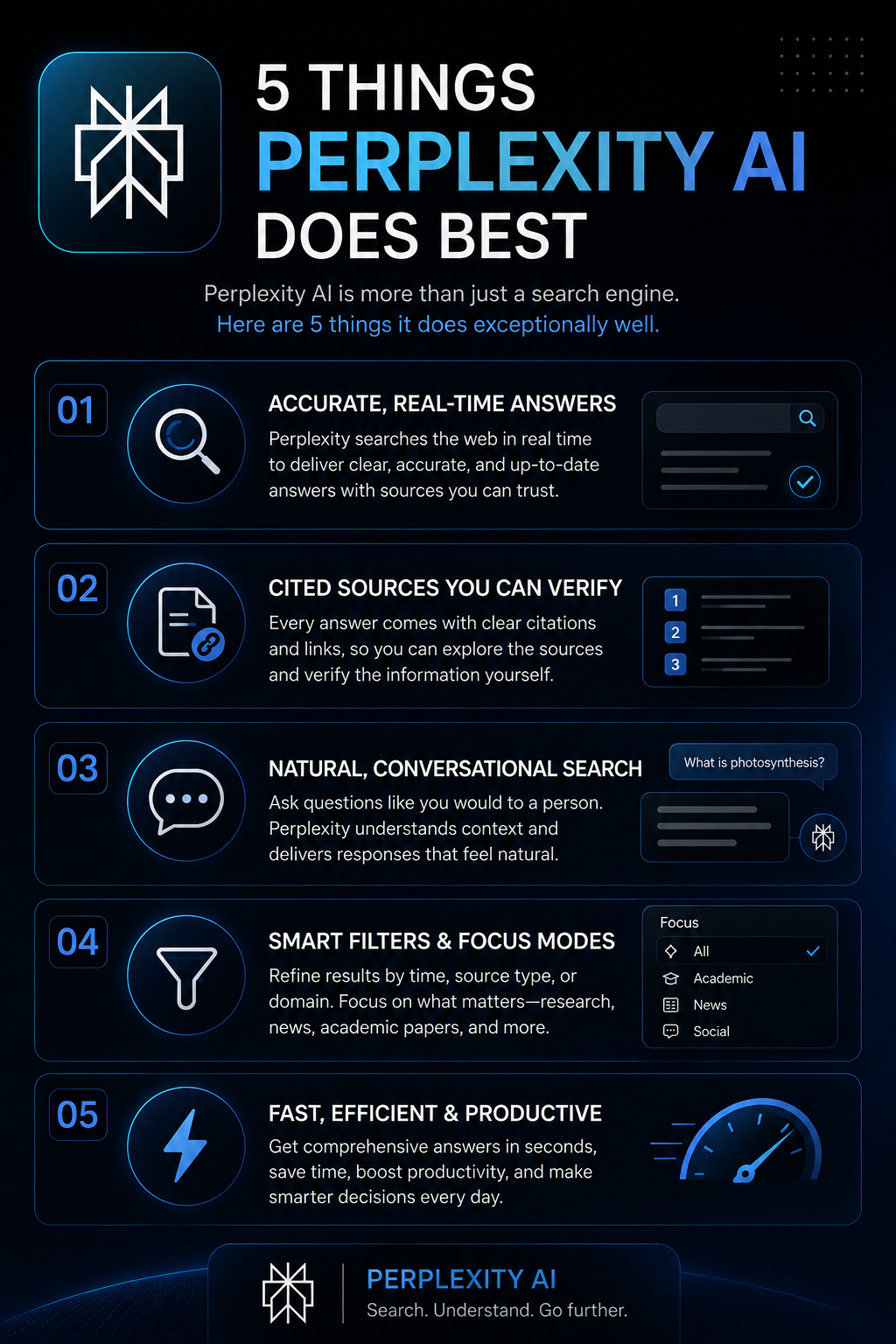
Artificial intelligence has changed the way people search for information, learn new subjects, conduct research, and solve problems. Traditional search engines are excellent at finding webpages, but users often have to open several links, read through different articles, compare information, and decide which sources are trustworthy. Perplexity AI takes a different approach. It combines web search with artificial intelligence to research a question and present the information in a conversational answer, while providing citations and links that allow users to check the original sources.
Perplexity is therefore best understood not simply as a chatbot, but as an AI-powered answer and research engine. Its greatest strength is bringing search, information gathering, source discovery, summarization, reasoning, and conversation together in one experience.
1. Finding Current Information
One of the most important things Perplexity does well is finding information from the web in real time.
The internet changes constantly. News develops every day, companies release new products, prices change, sports results are updated, technologies evolve, and government policies can be modified. An AI system that relies only on information it learned during training may not know what happened recently.
Perplexity is designed around web-connected search. According to its official documentation, it searches the web in real time and uses the information it finds to produce current answers.
This makes it particularly useful for questions such as:
- What are the latest developments in artificial intelligence?
- What is happening in a particular industry?
- What are the newest features of a product?
- What are today's major news stories?
- What are the current specifications of a device?
- What has recently changed about a particular company or technology?
Instead of requiring the user to search for every piece of information separately, Perplexity can investigate the question and combine relevant information into a response.
This is one of its biggest advantages: it turns searching into a conversation.
2. Providing Answers Instead of Just Links
Traditional search engines generally present users with a collection of links. Those links can be extremely useful, but finding the actual answer may require opening several pages.
Perplexity's approach is different. It attempts to understand the question, search for relevant information, and synthesize that information into a direct answer. Perplexity itself describes this as functioning as an "answer engine" rather than simply providing a list of search results.
For example, imagine someone asks:
"What are the main differences between electric cars and petrol cars?"
A traditional search could provide thousands of webpages.
Perplexity can instead research the topic and organize the answer into categories such as:
- Running costs
- Fuel or charging
- Maintenance
- Performance
- Environmental considerations
- Driving range
- Advantages and disadvantages
This saves the user from manually collecting the information.
The real strength is therefore not simply finding information. It is turning scattered information into something easier to understand.
3. Citing Its Sources
Another major strength of Perplexity is its emphasis on citations.
When an AI gives an answer, an important question immediately follows:
"Where did this information come from?"
Perplexity addresses this by providing citations and links to sources alongside its answers. Its official documentation states that responses include citations and links to original sources so users can verify the information and investigate further.
This is especially useful for research.
Suppose a student is researching climate change. Instead of receiving only an AI-generated explanation, the student can also examine the sources behind the information.
Similarly, someone researching a business can follow the cited articles, reports, company information, or other sources.
This makes Perplexity particularly strong for users who do not simply want an answer but also want to know where the answer came from.
However, citations do not automatically make every answer correct. Users should still open important sources and verify significant claims, especially for medical, financial, legal, or other high-stakes information.
4. Researching Complex Questions
Perplexity is particularly powerful when a question requires more than one search.
Simple questions can often be answered quickly. Complex questions may require searching multiple websites, comparing information, reading documents, identifying disagreements, and connecting ideas.
This is where Perplexity's advanced search capabilities become particularly useful.
Its Pro Search feature is designed to conduct multiple searches and synthesize information from a diverse set of sources.
For even deeper investigations, Perplexity provides Research mode. According to its documentation, Research can perform dozens of searches, read hundreds of sources, reason through the information, and produce a comprehensive report.
This can be useful for subjects such as:
- Technology research
- Business analysis
- Market research
- Academic research
- Travel planning
- Current affairs
- Product comparisons
- Industry research
- Complex technical subjects
Instead of asking the user to perform every individual search, the system can take on much of the information-gathering process.
That is one of the areas where Perplexity can feel less like a search engine and more like a digital research assistant.
5. Summarizing Large Amounts of Information
Another thing Perplexity does well is summarization.
The internet contains enormous amounts of information. A single topic may have thousands of articles, research papers, reports, interviews, videos, and webpages.
Reading everything manually is often impossible.
Perplexity can help by extracting important information and presenting it in a shorter, more understandable form. Its official guidance specifically highlights summarizing articles, documents, and webpages as a practical use case.
For example, someone could provide a long document and ask:
"Summarize this in simple English."
Or:
"Give me the five most important points."
Or:
"Explain this report as if I am a beginner."
This ability is valuable for students, researchers, professionals, entrepreneurs, and anyone who needs to understand large quantities of information quickly.
The important point is that Perplexity does not simply make information shorter. It can also organize the information into categories, explanations, comparisons, and conclusions.
6. Conversational Search
Perplexity is also very good at conversational searching.
Instead of treating every search as a completely separate event, users can continue asking questions about the same subject.
For example:
User: "What is artificial intelligence?"
Then:
User: "What are the main types?"
Then:
User: "Which one is used in chatbots?"
Then:
User: "Give me three examples."
This creates a natural research process.
Rather than repeatedly starting from the beginning, the user can gradually explore the subject.
This is especially useful when someone does not know exactly what they are looking for at the beginning. They can start with a broad question and use follow-up questions to move deeper into the topic.
Perplexity's Pro Search documentation specifically describes interactive refinement and maintaining context through follow-up questions.
This makes research feel much more natural.
7. Comparing Products, Services, and Ideas
Perplexity is also excellent for comparison tasks.
People frequently need to compare two or more options before making a decision.
For example:
"Compare the iPhone and Samsung Galaxy for photography."
Or:
"Compare Python and JavaScript for beginners."
Or:
"Compare two universities based on tuition, courses, location, and reputation."
A useful comparison requires gathering information from multiple sources and organizing it according to the same criteria.
Perplexity can research the relevant information and present the comparison in an organized format.
Its advanced research tools are specifically positioned for complex queries and product comparisons.
This can save significant time because users do not have to independently research every option before comparing them.
8. Helping Students Learn
Perplexity is also becoming increasingly useful as a learning tool.
Instead of using AI only to obtain an answer, students can use it to explore subjects, ask follow-up questions, request explanations, and investigate sources.
Perplexity's Learn Mode is designed specifically around active learning. Its documentation says the mode can break subjects down step by step and support activities such as interactive exercises, flashcards, and multiple-choice quizzes.
This is important because effective learning is not simply about receiving answers.
A good learning assistant should help a student understand why something is correct.
For example, a student studying mathematics could ask for a step-by-step explanation. A student studying history could ask for a timeline. Someone learning programming could ask for an explanation of a piece of code and then ask follow-up questions.
This makes Perplexity useful as an educational research companion.
9. Searching Academic and Specialized Information
Perplexity can also be useful when a person needs more specialized information.
Research often requires more than general webpages. Academic papers, professional publications, industry reports, and specialized databases can provide higher-quality information for particular questions.
Perplexity supports focused sources and has expanded its access to specialized and premium data sources. Its documentation describes sources such as academic material and professional data providers that can be used to enrich answers.
This can be valuable for:
- Students writing assignments
- Researchers investigating a subject
- Businesses analyzing markets
- Professionals researching industries
- Developers investigating technical problems
- People studying specialized subjects
The ability to combine information discovery with source citations makes this particularly useful for research-heavy tasks.
10. Working With Different AI Models
Another interesting feature of Perplexity is that it combines web search with multiple AI models.
Perplexity's current documentation explains that the platform combines models developed by Perplexity with models from major third-party providers. Depending on the plan and mode, users may have access to different models.
This is important because different AI models can have different strengths.
One model might be particularly useful for reasoning. Another might perform strongly on writing or coding. Another may be useful for a particular type of complex task.
Perplexity's model selection and search modes are designed to allow users or the system to choose an appropriate model for a particular task.
This means that Perplexity's value does not depend entirely on one AI model. Instead, it combines models + search + sources + research tools into one experience.
11. Turning Research Into Reports
Research is only useful if people can actually use the results.
Perplexity's Research feature can transform its investigation into a structured report. Its documentation describes the ability to synthesize researched information into comprehensive reports and export or share the results.
This is useful for people who need to transform research into something presentable.
For example, a person could research:
"The future of electric vehicles in Africa."
The research could cover:
- Market growth
- Infrastructure
- Charging stations
- Vehicle prices
- Government policies
- Consumer adoption
- Challenges
- Future opportunities
Instead of receiving a pile of unrelated search results, the user can obtain a structured research report.
That is a major productivity advantage.
12. Helping People Save Time
Perhaps the simplest way to describe Perplexity's greatest strength is time saving.
Imagine that someone needs to research a subject manually.
They might:
1. Search Google or another search engine.
2. Open several websites.
3. Read different articles.
4. Compare conflicting information.
5. Take notes.
6. Search for additional sources.
7. Organize the information.
8. Write a summary.
9. Find citations.
10. Repeat the process when something is missing.
Perplexity can automate or simplify many of these steps.
It can search, summarize, compare, explain, cite, and organize information in a single workflow.
That does not mean humans should stop checking information. Rather, it means that humans can spend more time thinking about the information instead of spending all their time collecting it.
13. Helping With Everyday Questions
Perplexity is not only for professional researchers.
It can also be useful for everyday questions.
Someone might ask:
- "What should I know before visiting this city?"
- "How does this phone compare with that phone?"
- "Explain this technology simply."
- "What are the advantages and disadvantages of this decision?"
- "Help me understand this news story."
- "What are the latest developments in this topic?"
- "Teach me the basics of Python."
The platform's own examples include everyday questions as well as more complex research tasks.
This flexibility is important because people do not always know whether they need a search engine, a chatbot, or a research tool.
Perplexity attempts to combine those experiences.
14. Helping Developers and Technical Users
Perplexity is not only a consumer-facing research product.
It also provides an API platform that allows developers to bring real-time, web-grounded intelligence into their own applications. Its API documentation describes capabilities for search, question answering, autonomous agents, retrieval pipelines, and other applications.
This means developers can build their own applications around Perplexity's search infrastructure.
For example, a developer could create an application that needs current web information without building an entire web-search infrastructure from scratch.
The API can be useful for:
- AI applications
- Search systems
- Question-answering systems
- Research tools
- Retrieval-augmented generation
- AI agents
- Developer products
This extends Perplexity beyond being an application that people use directly. Its technology can also become part of other software.
15. Organizing Long-Term Research
Perplexity is also increasingly focused on projects and persistent research.
Its Projects feature provides a persistent workspace where users can organize conversations, files, tasks, instructions, and other context around an ongoing effort.
This is useful because serious projects rarely happen in one conversation.
A student might spend weeks researching a school project.
A business owner might spend months researching a new business idea.
A developer might spend days investigating a technical problem.
A researcher might continuously collect information about a particular industry.
Having a dedicated workspace can make it easier to keep research organized instead of starting from zero every time.
16. Creating a More Efficient Research Workflow
Perplexity's greatest advantage becomes clearer when all of these features are combined.
Imagine someone wants to investigate a new technology.
They could begin with a normal search to understand the basics.
Then they could ask follow-up questions.
Next, they could use advanced search to investigate technical details.
They could examine citations and original sources.
They could compare different technologies.
They could use Research mode for a deeper investigation.
They could organize the work in a Project.
Finally, they could turn the findings into a report.
This creates a complete research workflow:
Question → Search → Sources → Analysis → Comparison → Verification → Report.
That is what makes Perplexity particularly powerful.
17. What Makes Perplexity Different?
Perplexity's biggest difference is the combination of search and AI reasoning.
A traditional search engine is primarily designed to help users find webpages.
A conventional chatbot is primarily designed to generate responses based on its model and the context it receives.
Perplexity combines the two approaches by searching the web and then using AI to synthesize the information into a conversational response with citations.
This means that the user does not always have to choose between:
"I want to search the internet."
and
"I want to talk to an AI."
Perplexity tries to provide both.
18. The Importance of Verification
Although Perplexity is powerful, one of the most important principles when using it is verification.
AI systems can make mistakes. Search results can contain inaccurate information. Sources can disagree. A webpage can be outdated or misleading.
Perplexity itself encourages users to double-check sources for additional confidence.
Therefore, its citations should not simply be treated as decoration.
They are valuable because they give the user an opportunity to investigate the original information.
For important decisions, users should read the sources themselves and compare evidence rather than blindly accepting an AI-generated answer.
This is especially important when researching medicine, law, finance, safety, politics, or other areas where incorrect information could cause serious consequences.
Conclusion
Perplexity AI does its best work when people need to find, understand, compare, verify, and organize information quickly.
Its biggest strengths include real-time web search, direct answers, citations, conversational research, advanced search, deep research, summarization, product and idea comparisons, educational support, specialized sources, multiple AI models, project organization, report creation, and developer APIs.
What makes Perplexity especially interesting is that these capabilities work together. It is not merely a place where someone types a question and receives an AI-generated paragraph. It is designed to help people move through an entire information-discovery process.
A person can start with a simple question, discover sources, ask follow-up questions, investigate complicated subjects, compare different viewpoints, examine citations, conduct deeper research, and turn the results into useful work.
In a world where there is more information available than ever before, the challenge is no longer simply finding information. The challenge is finding the right information, understanding it, determining where it came from, and turning it into something useful.
That is where Perplexity is at its strongest.
Its core idea can be summarized in three words:
Search. Understand. Go further.
And that is ultimately what Perplexity does best: it transforms web search from a process of hunting through links into a more conversational, research-focused experience where information can be discovered, explained, sourced, compared, and explored.
Perplexity is therefore best understood not simply as a chatbot, but as an AI-powered answer and research engine. Its greatest strength is bringing search, information gathering, source discovery, summarization, reasoning, and conversation together in one experience.
1. Finding Current Information
One of the most important things Perplexity does well is finding information from the web in real time.
The internet changes constantly. News develops every day, companies release new products, prices change, sports results are updated, technologies evolve, and government policies can be modified. An AI system that relies only on information it learned during training may not know what happened recently.
Perplexity is designed around web-connected search. According to its official documentation, it searches the web in real time and uses the information it finds to produce current answers.
This makes it particularly useful for questions such as:
- What are the latest developments in artificial intelligence?
- What is happening in a particular industry?
- What are the newest features of a product?
- What are today's major news stories?
- What are the current specifications of a device?
- What has recently changed about a particular company or technology?
Instead of requiring the user to search for every piece of information separately, Perplexity can investigate the question and combine relevant information into a response.
This is one of its biggest advantages: it turns searching into a conversation.
2. Providing Answers Instead of Just Links
Traditional search engines generally present users with a collection of links. Those links can be extremely useful, but finding the actual answer may require opening several pages.
Perplexity's approach is different. It attempts to understand the question, search for relevant information, and synthesize that information into a direct answer. Perplexity itself describes this as functioning as an "answer engine" rather than simply providing a list of search results.
For example, imagine someone asks:
"What are the main differences between electric cars and petrol cars?"
A traditional search could provide thousands of webpages.
Perplexity can instead research the topic and organize the answer into categories such as:
- Running costs
- Fuel or charging
- Maintenance
- Performance
- Environmental considerations
- Driving range
- Advantages and disadvantages
This saves the user from manually collecting the information.
The real strength is therefore not simply finding information. It is turning scattered information into something easier to understand.
3. Citing Its Sources
Another major strength of Perplexity is its emphasis on citations.
When an AI gives an answer, an important question immediately follows:
"Where did this information come from?"
Perplexity addresses this by providing citations and links to sources alongside its answers. Its official documentation states that responses include citations and links to original sources so users can verify the information and investigate further.
This is especially useful for research.
Suppose a student is researching climate change. Instead of receiving only an AI-generated explanation, the student can also examine the sources behind the information.
Similarly, someone researching a business can follow the cited articles, reports, company information, or other sources.
This makes Perplexity particularly strong for users who do not simply want an answer but also want to know where the answer came from.
However, citations do not automatically make every answer correct. Users should still open important sources and verify significant claims, especially for medical, financial, legal, or other high-stakes information.
4. Researching Complex Questions
Perplexity is particularly powerful when a question requires more than one search.
Simple questions can often be answered quickly. Complex questions may require searching multiple websites, comparing information, reading documents, identifying disagreements, and connecting ideas.
This is where Perplexity's advanced search capabilities become particularly useful.
Its Pro Search feature is designed to conduct multiple searches and synthesize information from a diverse set of sources.
For even deeper investigations, Perplexity provides Research mode. According to its documentation, Research can perform dozens of searches, read hundreds of sources, reason through the information, and produce a comprehensive report.
This can be useful for subjects such as:
- Technology research
- Business analysis
- Market research
- Academic research
- Travel planning
- Current affairs
- Product comparisons
- Industry research
- Complex technical subjects
Instead of asking the user to perform every individual search, the system can take on much of the information-gathering process.
That is one of the areas where Perplexity can feel less like a search engine and more like a digital research assistant.
5. Summarizing Large Amounts of Information
Another thing Perplexity does well is summarization.
The internet contains enormous amounts of information. A single topic may have thousands of articles, research papers, reports, interviews, videos, and webpages.
Reading everything manually is often impossible.
Perplexity can help by extracting important information and presenting it in a shorter, more understandable form. Its official guidance specifically highlights summarizing articles, documents, and webpages as a practical use case.
For example, someone could provide a long document and ask:
"Summarize this in simple English."
Or:
"Give me the five most important points."
Or:
"Explain this report as if I am a beginner."
This ability is valuable for students, researchers, professionals, entrepreneurs, and anyone who needs to understand large quantities of information quickly.
The important point is that Perplexity does not simply make information shorter. It can also organize the information into categories, explanations, comparisons, and conclusions.
6. Conversational Search
Perplexity is also very good at conversational searching.
Instead of treating every search as a completely separate event, users can continue asking questions about the same subject.
For example:
User: "What is artificial intelligence?"
Then:
User: "What are the main types?"
Then:
User: "Which one is used in chatbots?"
Then:
User: "Give me three examples."
This creates a natural research process.
Rather than repeatedly starting from the beginning, the user can gradually explore the subject.
This is especially useful when someone does not know exactly what they are looking for at the beginning. They can start with a broad question and use follow-up questions to move deeper into the topic.
Perplexity's Pro Search documentation specifically describes interactive refinement and maintaining context through follow-up questions.
This makes research feel much more natural.
7. Comparing Products, Services, and Ideas
Perplexity is also excellent for comparison tasks.
People frequently need to compare two or more options before making a decision.
For example:
"Compare the iPhone and Samsung Galaxy for photography."
Or:
"Compare Python and JavaScript for beginners."
Or:
"Compare two universities based on tuition, courses, location, and reputation."
A useful comparison requires gathering information from multiple sources and organizing it according to the same criteria.
Perplexity can research the relevant information and present the comparison in an organized format.
Its advanced research tools are specifically positioned for complex queries and product comparisons.
This can save significant time because users do not have to independently research every option before comparing them.
8. Helping Students Learn
Perplexity is also becoming increasingly useful as a learning tool.
Instead of using AI only to obtain an answer, students can use it to explore subjects, ask follow-up questions, request explanations, and investigate sources.
Perplexity's Learn Mode is designed specifically around active learning. Its documentation says the mode can break subjects down step by step and support activities such as interactive exercises, flashcards, and multiple-choice quizzes.
This is important because effective learning is not simply about receiving answers.
A good learning assistant should help a student understand why something is correct.
For example, a student studying mathematics could ask for a step-by-step explanation. A student studying history could ask for a timeline. Someone learning programming could ask for an explanation of a piece of code and then ask follow-up questions.
This makes Perplexity useful as an educational research companion.
9. Searching Academic and Specialized Information
Perplexity can also be useful when a person needs more specialized information.
Research often requires more than general webpages. Academic papers, professional publications, industry reports, and specialized databases can provide higher-quality information for particular questions.
Perplexity supports focused sources and has expanded its access to specialized and premium data sources. Its documentation describes sources such as academic material and professional data providers that can be used to enrich answers.
This can be valuable for:
- Students writing assignments
- Researchers investigating a subject
- Businesses analyzing markets
- Professionals researching industries
- Developers investigating technical problems
- People studying specialized subjects
The ability to combine information discovery with source citations makes this particularly useful for research-heavy tasks.
10. Working With Different AI Models
Another interesting feature of Perplexity is that it combines web search with multiple AI models.
Perplexity's current documentation explains that the platform combines models developed by Perplexity with models from major third-party providers. Depending on the plan and mode, users may have access to different models.
This is important because different AI models can have different strengths.
One model might be particularly useful for reasoning. Another might perform strongly on writing or coding. Another may be useful for a particular type of complex task.
Perplexity's model selection and search modes are designed to allow users or the system to choose an appropriate model for a particular task.
This means that Perplexity's value does not depend entirely on one AI model. Instead, it combines models + search + sources + research tools into one experience.
11. Turning Research Into Reports
Research is only useful if people can actually use the results.
Perplexity's Research feature can transform its investigation into a structured report. Its documentation describes the ability to synthesize researched information into comprehensive reports and export or share the results.
This is useful for people who need to transform research into something presentable.
For example, a person could research:
"The future of electric vehicles in Africa."
The research could cover:
- Market growth
- Infrastructure
- Charging stations
- Vehicle prices
- Government policies
- Consumer adoption
- Challenges
- Future opportunities
Instead of receiving a pile of unrelated search results, the user can obtain a structured research report.
That is a major productivity advantage.
12. Helping People Save Time
Perhaps the simplest way to describe Perplexity's greatest strength is time saving.
Imagine that someone needs to research a subject manually.
They might:
1. Search Google or another search engine.
2. Open several websites.
3. Read different articles.
4. Compare conflicting information.
5. Take notes.
6. Search for additional sources.
7. Organize the information.
8. Write a summary.
9. Find citations.
10. Repeat the process when something is missing.
Perplexity can automate or simplify many of these steps.
It can search, summarize, compare, explain, cite, and organize information in a single workflow.
That does not mean humans should stop checking information. Rather, it means that humans can spend more time thinking about the information instead of spending all their time collecting it.
13. Helping With Everyday Questions
Perplexity is not only for professional researchers.
It can also be useful for everyday questions.
Someone might ask:
- "What should I know before visiting this city?"
- "How does this phone compare with that phone?"
- "Explain this technology simply."
- "What are the advantages and disadvantages of this decision?"
- "Help me understand this news story."
- "What are the latest developments in this topic?"
- "Teach me the basics of Python."
The platform's own examples include everyday questions as well as more complex research tasks.
This flexibility is important because people do not always know whether they need a search engine, a chatbot, or a research tool.
Perplexity attempts to combine those experiences.
14. Helping Developers and Technical Users
Perplexity is not only a consumer-facing research product.
It also provides an API platform that allows developers to bring real-time, web-grounded intelligence into their own applications. Its API documentation describes capabilities for search, question answering, autonomous agents, retrieval pipelines, and other applications.
This means developers can build their own applications around Perplexity's search infrastructure.
For example, a developer could create an application that needs current web information without building an entire web-search infrastructure from scratch.
The API can be useful for:
- AI applications
- Search systems
- Question-answering systems
- Research tools
- Retrieval-augmented generation
- AI agents
- Developer products
This extends Perplexity beyond being an application that people use directly. Its technology can also become part of other software.
15. Organizing Long-Term Research
Perplexity is also increasingly focused on projects and persistent research.
Its Projects feature provides a persistent workspace where users can organize conversations, files, tasks, instructions, and other context around an ongoing effort.
This is useful because serious projects rarely happen in one conversation.
A student might spend weeks researching a school project.
A business owner might spend months researching a new business idea.
A developer might spend days investigating a technical problem.
A researcher might continuously collect information about a particular industry.
Having a dedicated workspace can make it easier to keep research organized instead of starting from zero every time.
16. Creating a More Efficient Research Workflow
Perplexity's greatest advantage becomes clearer when all of these features are combined.
Imagine someone wants to investigate a new technology.
They could begin with a normal search to understand the basics.
Then they could ask follow-up questions.
Next, they could use advanced search to investigate technical details.
They could examine citations and original sources.
They could compare different technologies.
They could use Research mode for a deeper investigation.
They could organize the work in a Project.
Finally, they could turn the findings into a report.
This creates a complete research workflow:
Question → Search → Sources → Analysis → Comparison → Verification → Report.
That is what makes Perplexity particularly powerful.
17. What Makes Perplexity Different?
Perplexity's biggest difference is the combination of search and AI reasoning.
A traditional search engine is primarily designed to help users find webpages.
A conventional chatbot is primarily designed to generate responses based on its model and the context it receives.
Perplexity combines the two approaches by searching the web and then using AI to synthesize the information into a conversational response with citations.
This means that the user does not always have to choose between:
"I want to search the internet."
and
"I want to talk to an AI."
Perplexity tries to provide both.
18. The Importance of Verification
Although Perplexity is powerful, one of the most important principles when using it is verification.
AI systems can make mistakes. Search results can contain inaccurate information. Sources can disagree. A webpage can be outdated or misleading.
Perplexity itself encourages users to double-check sources for additional confidence.
Therefore, its citations should not simply be treated as decoration.
They are valuable because they give the user an opportunity to investigate the original information.
For important decisions, users should read the sources themselves and compare evidence rather than blindly accepting an AI-generated answer.
This is especially important when researching medicine, law, finance, safety, politics, or other areas where incorrect information could cause serious consequences.
Conclusion
Perplexity AI does its best work when people need to find, understand, compare, verify, and organize information quickly.
Its biggest strengths include real-time web search, direct answers, citations, conversational research, advanced search, deep research, summarization, product and idea comparisons, educational support, specialized sources, multiple AI models, project organization, report creation, and developer APIs.
What makes Perplexity especially interesting is that these capabilities work together. It is not merely a place where someone types a question and receives an AI-generated paragraph. It is designed to help people move through an entire information-discovery process.
A person can start with a simple question, discover sources, ask follow-up questions, investigate complicated subjects, compare different viewpoints, examine citations, conduct deeper research, and turn the results into useful work.
In a world where there is more information available than ever before, the challenge is no longer simply finding information. The challenge is finding the right information, understanding it, determining where it came from, and turning it into something useful.
That is where Perplexity is at its strongest.
Its core idea can be summarized in three words:
Search. Understand. Go further.
And that is ultimately what Perplexity does best: it transforms web search from a process of hunting through links into a more conversational, research-focused experience where information can be discovered, explained, sourced, compared, and explored.