What VoiceFlow Bot Builder does best

Martins Aligwe
August 19, 2026
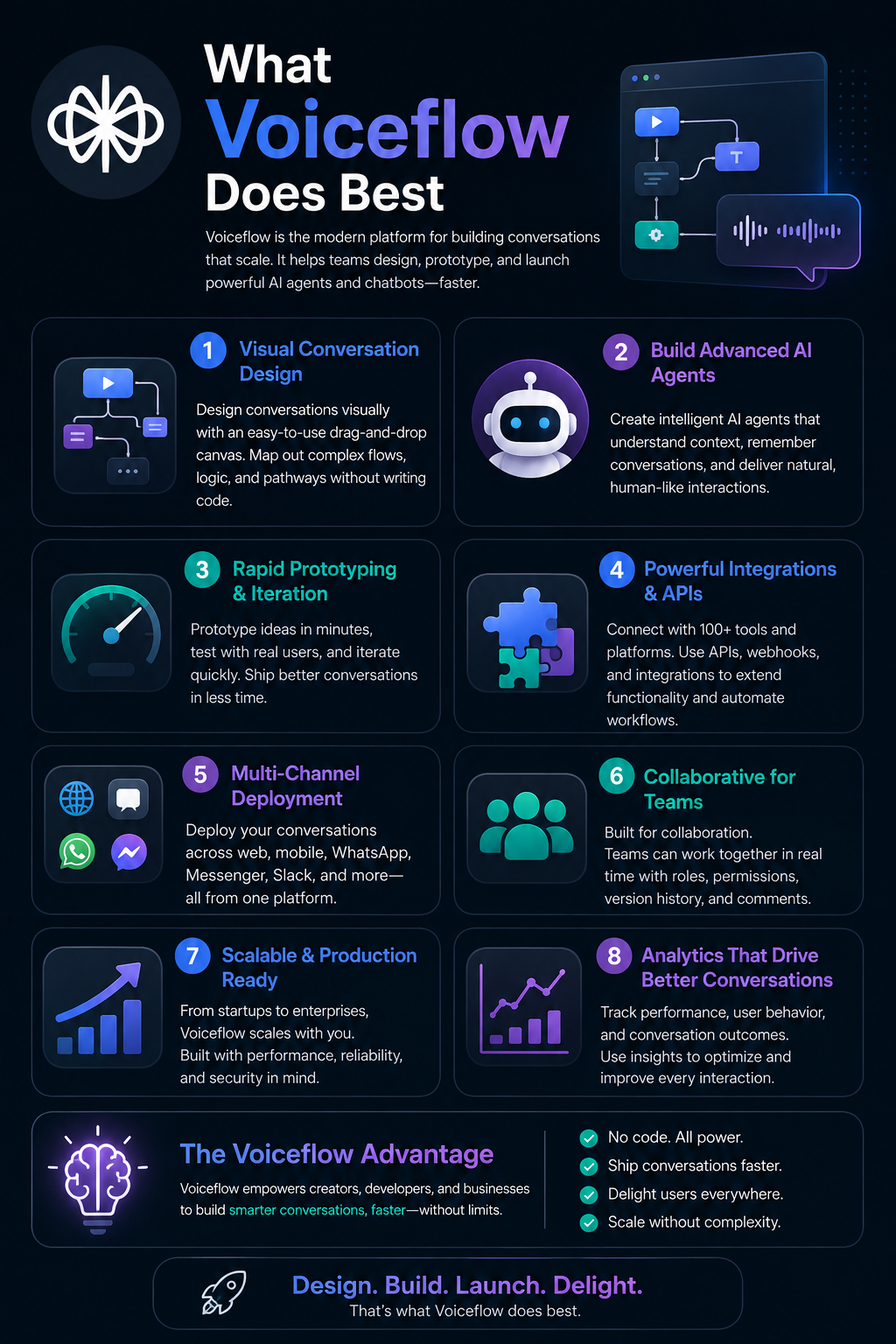
What Voiceflow Bot Builder Does Best
In today’s rapidly changing digital world, businesses are constantly looking for better ways to communicate with their customers, provide instant support, and automate repetitive tasks. One of the tools that has become increasingly useful for creating AI-powered conversational experiences is Voiceflow Bot Builder. Voiceflow is a platform designed to help people build, test, and deploy conversational AI agents and chatbots without requiring them to be expert programmers. Its strength lies in making the process of designing intelligent conversations more visual, organized, collaborative, and accessible.
Introduction to Voiceflow Bot Builder
Voiceflow Bot Builder is a platform for designing and developing conversational experiences. It allows users to create chatbots and AI agents that can communicate with people through natural language. Instead of having to write every part of a chatbot from scratch using complicated programming languages, users can visually design how the conversation should work.
The platform is especially useful for businesses, developers, designers, marketers, customer-support teams, and people who want to experiment with artificial intelligence. A user can design a conversation, connect different actions and responses, test the experience, improve it, and eventually make it available to customers.
One of the biggest advantages of Voiceflow is that it brings several parts of the chatbot-building process into one environment. Rather than designing the conversation in one application, programming it somewhere else, testing it in another tool, and documenting everything separately, Voiceflow provides a centralized workspace for much of this work.
1. Visual Conversation Design
One of the things Voiceflow does best is visual conversation design. Instead of looking at thousands of lines of code, users can work with a visual interface that represents different parts of a conversation.
For example, a customer might begin by saying, “I want to know the price of this product.” The bot can respond with information about the product and then ask whether the customer wants to purchase it. If the customer says yes, the conversation can continue toward purchasing or contacting a sales representative.
This type of conversation can be represented visually, allowing the creator to understand how the experience flows from one stage to another.
Visual design is particularly helpful for beginners because it makes complicated conversational logic easier to understand. It also helps experienced teams organize large projects and identify missing steps, unnecessary conversations, or confusing paths.
2. Building AI-Powered Chatbots
Another major strength of Voiceflow is its ability to help users build AI-powered chatbots. Traditional chatbots often depend heavily on predefined questions and answers. If a customer asks something in a way the developer did not anticipate, the chatbot may fail to understand.
AI-powered bots can be more flexible. They can use natural-language understanding and AI models to interpret what users are trying to say.
For example, a customer might ask:
«“How much does your premium package cost?”»
Another customer might ask:
«“What is the price of the top plan?”»
Although the questions are worded differently, they may have the same intention. An AI-powered conversational agent can be designed to recognize that similarity and provide the appropriate response.
This makes Voiceflow particularly useful for creating modern customer-service and business assistants.
3. Creating Natural Conversations
Voiceflow is also strong at helping creators design conversations that feel more natural. A good chatbot should not simply provide random answers. It should understand the context of a conversation and guide the user toward a useful outcome.
For example, imagine a customer asks:
“Do you deliver?”
The bot might answer:
“Yes, we deliver nationwide. Which state would you like us to deliver to?”
The customer could then respond:
“Rivers.”
Instead of starting the conversation again, a properly designed AI agent can continue from the previous context and provide relevant information.
This ability to structure conversations around context is one of the important differences between a basic FAQ chatbot and a more sophisticated AI assistant.
4. Knowledge-Based AI
Another area where Voiceflow can be particularly useful is connecting an AI agent to information that a business already has.
Businesses often have information stored in documents, websites, help centers, FAQs, product descriptions, policies, and other sources. A conversational agent can be designed to use relevant business information when answering questions.
For example, an online store could have information about:
- Products
- Prices
- Delivery
- Returns
- Refunds
- Opening hours
- Frequently asked questions
- Company policies
Instead of forcing customers to search through several pages, an AI assistant can help them find the information through conversation.
This can make information easier to access and can improve the customer experience.
5. Customer Support Automation
Voiceflow is well suited for customer-support automation. Many businesses receive repetitive questions every day. Customers may repeatedly ask about delivery times, account information, product availability, opening hours, pricing, and company policies.
A conversational AI agent can handle many common questions automatically.
For example, instead of a customer-service employee answering the same question hundreds of times, an AI assistant can provide an immediate response to common requests.
This does not mean human employees become unnecessary. More importantly, automation can allow human workers to focus on complicated situations that require judgment, empathy, or direct human involvement.
A well-designed Voiceflow agent can therefore act as a first point of contact before transferring more difficult problems to a human representative.
6. Prototyping AI Agents Quickly
Voiceflow is also useful for rapid prototyping. Before a company invests significant time and money into developing a complete AI application, it can first create a prototype to test the idea.
Suppose a company wants to build an AI shopping assistant. Instead of immediately hiring a large development team to create the complete system, the company could first design a prototype that demonstrates how customers would interact with the assistant.
The team can test questions, responses, conversation flows, and user experiences. If something does not work well, they can change it before investing heavily in the final product.
This makes Voiceflow valuable not only for production systems but also for experimentation and product development.
7. Testing and Improving Conversations
Creating a chatbot is only the beginning. A chatbot must also be tested.
Voiceflow helps creators examine how an AI agent behaves when users ask different questions. This is important because real customers do not always communicate in the exact way the developer expects.
For example, a developer might expect a user to say:
“I want to cancel my order.”
But a real customer might say:
“Please stop my order.”
Or:
“I don't want the package anymore.”
The system needs to be designed to handle variations like these appropriately.
Testing allows developers and designers to discover weaknesses and improve the conversation before customers encounter those problems.
8. Connecting AI to Business Workflows
A powerful chatbot should not simply talk. It should also help users accomplish tasks.
This is another area where Voiceflow can be useful. AI agents can be designed to interact with external systems and workflows where appropriate.
For example, a business assistant might help a customer:
1. Ask about a product.
2. Collect information from the customer.
3. Check relevant business information.
4. Guide the customer toward the next step.
5. Send information to another system.
6. Connect the customer with a human representative when necessary.
This makes conversational AI more useful because it becomes part of a business process rather than simply acting as a question-and-answer machine.
9. Collaboration Between Teams
Voiceflow is not only about technology. It can also support collaboration.
Building a successful conversational AI system often requires several types of people. A designer may focus on the user experience, a developer may focus on technical integrations, a marketing specialist may focus on customer needs, and a business owner may focus on the overall goals.
A shared workspace can make it easier for these people to work on the same project.
Instead of one person creating the chatbot while everyone else has to guess how it works, the team can work from a common design and improve the system together.
10. Making AI Development More Accessible
Perhaps one of Voiceflow’s most important strengths is accessibility.
Artificial intelligence can seem complicated to people who are not programmers. Concepts such as APIs, databases, prompts, variables, integrations, and conversation logic can initially be difficult to understand.
Voiceflow helps simplify the process by presenting many of these concepts through a visual development environment.
This does not mean that technical knowledge is completely unnecessary. Advanced projects may still require programming, APIs, databases, and other technical skills. However, Voiceflow can reduce the amount of traditional coding needed for many conversational AI projects.
As a result, people with backgrounds in design, marketing, business, education, and customer service can participate more directly in building AI experiences.
11. Designing Better User Experiences
A chatbot can be technically impressive but still be frustrating to use. Voiceflow's visual approach encourages creators to think about the complete user journey.
A good AI assistant should answer questions clearly, avoid unnecessary complexity, understand what the user is trying to accomplish, and provide useful next steps.
For example, instead of simply responding:
“Order information unavailable.”
A better conversational experience could explain the problem and provide alternatives:
“I couldn't find that order. Please check the order number, or I can connect you with our support team.”
The second response gives the user a path forward.
This demonstrates why conversational design is just as important as AI technology itself.
12. Useful for Different Types of Businesses
Voiceflow can be applied to many industries because conversational AI is useful in many different situations.
An online store could create an AI shopping assistant.
A school could create an assistant that answers questions about courses and school information.
A hotel could create an assistant that helps visitors learn about rooms, services, and reservations.
A technology company could build a support assistant that helps users troubleshoot common problems.
A financial organization could create an information assistant, subject to appropriate security and compliance requirements.
A marketing agency could build AI assistants for multiple clients.
The possibilities depend largely on the information, integrations, and workflows available to the organization.
13. Creating AI Agents Instead of Simple Bots
The modern AI landscape is moving beyond simple rule-based chatbots toward AI agents that can understand requests, use information, follow instructions, and potentially perform tasks.
Voiceflow is well positioned for this type of conversational experience because it provides tools for designing how an AI agent should behave.
For example, instead of creating a bot that only answers:
“What are your opening hours?”
an organization can design an assistant capable of handling a broader customer conversation.
The user might ask about a product, ask for recommendations, request additional information, and then ask what to do next. The agent can be designed around these broader goals rather than being limited to individual questions.
14. Reducing Development Complexity
Traditional chatbot development can involve writing code, managing backend systems, designing interfaces, handling AI integrations, testing responses, and maintaining documentation.
Voiceflow can simplify parts of this process by providing a dedicated environment for conversational AI development.
This can reduce the amount of time required to move from an idea to a working prototype.
For small businesses, this can be especially valuable because they may not have large development teams or the budget to build everything completely from scratch.
15. Helping Businesses Work 24/7
Another major benefit of conversational AI is availability.
Human employees cannot realistically answer customer questions every hour of every day. An AI assistant, however, can be designed to provide responses outside normal business hours.
A customer could visit a website late at night and ask about a product. Instead of seeing only a message saying that the business is closed, the customer could receive useful information from the AI assistant.
This can improve accessibility and reduce the number of customers who leave without finding an answer.
16. Improving Lead Generation
Voiceflow can also be useful for businesses interested in generating leads.
For example, a company could create an AI assistant that asks potential customers what they are looking for, collects relevant information, explains available services, and guides qualified prospects toward contacting the business.
Instead of a static website where visitors simply read information, the AI assistant can create an interactive experience.
This can make websites feel more engaging and can help businesses understand what their visitors need.
17. Supporting Multichannel Experiences
Modern customers communicate with businesses through many different channels. They may use websites, messaging platforms, applications, or other digital interfaces.
A conversational AI platform can help businesses think about how the same knowledge and conversational logic can support users across different experiences.
This is particularly valuable for businesses that want customers to receive consistent information regardless of where they interact with the company.
18. Voiceflow’s Greatest Strength: Combining Design and AI
When all these features are considered together, one of Voiceflow's biggest strengths becomes clear: it brings conversational design and AI development together in a visual environment.
It is not simply about making a chatbot respond to questions. It is about designing an entire conversational experience.
The creator can think about what the user wants, design the conversation, connect the AI to relevant information, add business logic, test the experience, and improve it.
This makes Voiceflow especially useful for people who want to build sophisticated AI experiences without starting from a completely blank coding environment.
Conclusion
Voiceflow Bot Builder does many things well, but its greatest strength is making the development of conversational AI more understandable, visual, and accessible.
It can help users create AI-powered chatbots and agents, design natural conversations, connect agents to business information, automate customer support, prototype ideas, test conversations, collaborate with teams, and connect AI experiences to broader business workflows.
For beginners, Voiceflow can provide a much easier starting point than building an entire conversational AI system from scratch. For experienced teams, it can provide an organized environment for designing and testing more advanced AI experiences.
The most important lesson is that a successful chatbot is not simply an AI model that produces answers. It is a carefully designed experience that understands users, provides useful information, guides people toward their goals, and knows when additional human assistance is needed.
That is where Voiceflow Bot Builder stands out. It helps turn an idea for an AI assistant into a structured, testable, and interactive conversational experience. As businesses continue to adopt artificial intelligence, tools that make AI easier to design, build, test, and improve will become increasingly important, and Voiceflow is one of the platforms designed to serve that need.
In today’s rapidly changing digital world, businesses are constantly looking for better ways to communicate with their customers, provide instant support, and automate repetitive tasks. One of the tools that has become increasingly useful for creating AI-powered conversational experiences is Voiceflow Bot Builder. Voiceflow is a platform designed to help people build, test, and deploy conversational AI agents and chatbots without requiring them to be expert programmers. Its strength lies in making the process of designing intelligent conversations more visual, organized, collaborative, and accessible.
Introduction to Voiceflow Bot Builder
Voiceflow Bot Builder is a platform for designing and developing conversational experiences. It allows users to create chatbots and AI agents that can communicate with people through natural language. Instead of having to write every part of a chatbot from scratch using complicated programming languages, users can visually design how the conversation should work.
The platform is especially useful for businesses, developers, designers, marketers, customer-support teams, and people who want to experiment with artificial intelligence. A user can design a conversation, connect different actions and responses, test the experience, improve it, and eventually make it available to customers.
One of the biggest advantages of Voiceflow is that it brings several parts of the chatbot-building process into one environment. Rather than designing the conversation in one application, programming it somewhere else, testing it in another tool, and documenting everything separately, Voiceflow provides a centralized workspace for much of this work.
1. Visual Conversation Design
One of the things Voiceflow does best is visual conversation design. Instead of looking at thousands of lines of code, users can work with a visual interface that represents different parts of a conversation.
For example, a customer might begin by saying, “I want to know the price of this product.” The bot can respond with information about the product and then ask whether the customer wants to purchase it. If the customer says yes, the conversation can continue toward purchasing or contacting a sales representative.
This type of conversation can be represented visually, allowing the creator to understand how the experience flows from one stage to another.
Visual design is particularly helpful for beginners because it makes complicated conversational logic easier to understand. It also helps experienced teams organize large projects and identify missing steps, unnecessary conversations, or confusing paths.
2. Building AI-Powered Chatbots
Another major strength of Voiceflow is its ability to help users build AI-powered chatbots. Traditional chatbots often depend heavily on predefined questions and answers. If a customer asks something in a way the developer did not anticipate, the chatbot may fail to understand.
AI-powered bots can be more flexible. They can use natural-language understanding and AI models to interpret what users are trying to say.
For example, a customer might ask:
«“How much does your premium package cost?”»
Another customer might ask:
«“What is the price of the top plan?”»
Although the questions are worded differently, they may have the same intention. An AI-powered conversational agent can be designed to recognize that similarity and provide the appropriate response.
This makes Voiceflow particularly useful for creating modern customer-service and business assistants.
3. Creating Natural Conversations
Voiceflow is also strong at helping creators design conversations that feel more natural. A good chatbot should not simply provide random answers. It should understand the context of a conversation and guide the user toward a useful outcome.
For example, imagine a customer asks:
“Do you deliver?”
The bot might answer:
“Yes, we deliver nationwide. Which state would you like us to deliver to?”
The customer could then respond:
“Rivers.”
Instead of starting the conversation again, a properly designed AI agent can continue from the previous context and provide relevant information.
This ability to structure conversations around context is one of the important differences between a basic FAQ chatbot and a more sophisticated AI assistant.
4. Knowledge-Based AI
Another area where Voiceflow can be particularly useful is connecting an AI agent to information that a business already has.
Businesses often have information stored in documents, websites, help centers, FAQs, product descriptions, policies, and other sources. A conversational agent can be designed to use relevant business information when answering questions.
For example, an online store could have information about:
- Products
- Prices
- Delivery
- Returns
- Refunds
- Opening hours
- Frequently asked questions
- Company policies
Instead of forcing customers to search through several pages, an AI assistant can help them find the information through conversation.
This can make information easier to access and can improve the customer experience.
5. Customer Support Automation
Voiceflow is well suited for customer-support automation. Many businesses receive repetitive questions every day. Customers may repeatedly ask about delivery times, account information, product availability, opening hours, pricing, and company policies.
A conversational AI agent can handle many common questions automatically.
For example, instead of a customer-service employee answering the same question hundreds of times, an AI assistant can provide an immediate response to common requests.
This does not mean human employees become unnecessary. More importantly, automation can allow human workers to focus on complicated situations that require judgment, empathy, or direct human involvement.
A well-designed Voiceflow agent can therefore act as a first point of contact before transferring more difficult problems to a human representative.
6. Prototyping AI Agents Quickly
Voiceflow is also useful for rapid prototyping. Before a company invests significant time and money into developing a complete AI application, it can first create a prototype to test the idea.
Suppose a company wants to build an AI shopping assistant. Instead of immediately hiring a large development team to create the complete system, the company could first design a prototype that demonstrates how customers would interact with the assistant.
The team can test questions, responses, conversation flows, and user experiences. If something does not work well, they can change it before investing heavily in the final product.
This makes Voiceflow valuable not only for production systems but also for experimentation and product development.
7. Testing and Improving Conversations
Creating a chatbot is only the beginning. A chatbot must also be tested.
Voiceflow helps creators examine how an AI agent behaves when users ask different questions. This is important because real customers do not always communicate in the exact way the developer expects.
For example, a developer might expect a user to say:
“I want to cancel my order.”
But a real customer might say:
“Please stop my order.”
Or:
“I don't want the package anymore.”
The system needs to be designed to handle variations like these appropriately.
Testing allows developers and designers to discover weaknesses and improve the conversation before customers encounter those problems.
8. Connecting AI to Business Workflows
A powerful chatbot should not simply talk. It should also help users accomplish tasks.
This is another area where Voiceflow can be useful. AI agents can be designed to interact with external systems and workflows where appropriate.
For example, a business assistant might help a customer:
1. Ask about a product.
2. Collect information from the customer.
3. Check relevant business information.
4. Guide the customer toward the next step.
5. Send information to another system.
6. Connect the customer with a human representative when necessary.
This makes conversational AI more useful because it becomes part of a business process rather than simply acting as a question-and-answer machine.
9. Collaboration Between Teams
Voiceflow is not only about technology. It can also support collaboration.
Building a successful conversational AI system often requires several types of people. A designer may focus on the user experience, a developer may focus on technical integrations, a marketing specialist may focus on customer needs, and a business owner may focus on the overall goals.
A shared workspace can make it easier for these people to work on the same project.
Instead of one person creating the chatbot while everyone else has to guess how it works, the team can work from a common design and improve the system together.
10. Making AI Development More Accessible
Perhaps one of Voiceflow’s most important strengths is accessibility.
Artificial intelligence can seem complicated to people who are not programmers. Concepts such as APIs, databases, prompts, variables, integrations, and conversation logic can initially be difficult to understand.
Voiceflow helps simplify the process by presenting many of these concepts through a visual development environment.
This does not mean that technical knowledge is completely unnecessary. Advanced projects may still require programming, APIs, databases, and other technical skills. However, Voiceflow can reduce the amount of traditional coding needed for many conversational AI projects.
As a result, people with backgrounds in design, marketing, business, education, and customer service can participate more directly in building AI experiences.
11. Designing Better User Experiences
A chatbot can be technically impressive but still be frustrating to use. Voiceflow's visual approach encourages creators to think about the complete user journey.
A good AI assistant should answer questions clearly, avoid unnecessary complexity, understand what the user is trying to accomplish, and provide useful next steps.
For example, instead of simply responding:
“Order information unavailable.”
A better conversational experience could explain the problem and provide alternatives:
“I couldn't find that order. Please check the order number, or I can connect you with our support team.”
The second response gives the user a path forward.
This demonstrates why conversational design is just as important as AI technology itself.
12. Useful for Different Types of Businesses
Voiceflow can be applied to many industries because conversational AI is useful in many different situations.
An online store could create an AI shopping assistant.
A school could create an assistant that answers questions about courses and school information.
A hotel could create an assistant that helps visitors learn about rooms, services, and reservations.
A technology company could build a support assistant that helps users troubleshoot common problems.
A financial organization could create an information assistant, subject to appropriate security and compliance requirements.
A marketing agency could build AI assistants for multiple clients.
The possibilities depend largely on the information, integrations, and workflows available to the organization.
13. Creating AI Agents Instead of Simple Bots
The modern AI landscape is moving beyond simple rule-based chatbots toward AI agents that can understand requests, use information, follow instructions, and potentially perform tasks.
Voiceflow is well positioned for this type of conversational experience because it provides tools for designing how an AI agent should behave.
For example, instead of creating a bot that only answers:
“What are your opening hours?”
an organization can design an assistant capable of handling a broader customer conversation.
The user might ask about a product, ask for recommendations, request additional information, and then ask what to do next. The agent can be designed around these broader goals rather than being limited to individual questions.
14. Reducing Development Complexity
Traditional chatbot development can involve writing code, managing backend systems, designing interfaces, handling AI integrations, testing responses, and maintaining documentation.
Voiceflow can simplify parts of this process by providing a dedicated environment for conversational AI development.
This can reduce the amount of time required to move from an idea to a working prototype.
For small businesses, this can be especially valuable because they may not have large development teams or the budget to build everything completely from scratch.
15. Helping Businesses Work 24/7
Another major benefit of conversational AI is availability.
Human employees cannot realistically answer customer questions every hour of every day. An AI assistant, however, can be designed to provide responses outside normal business hours.
A customer could visit a website late at night and ask about a product. Instead of seeing only a message saying that the business is closed, the customer could receive useful information from the AI assistant.
This can improve accessibility and reduce the number of customers who leave without finding an answer.
16. Improving Lead Generation
Voiceflow can also be useful for businesses interested in generating leads.
For example, a company could create an AI assistant that asks potential customers what they are looking for, collects relevant information, explains available services, and guides qualified prospects toward contacting the business.
Instead of a static website where visitors simply read information, the AI assistant can create an interactive experience.
This can make websites feel more engaging and can help businesses understand what their visitors need.
17. Supporting Multichannel Experiences
Modern customers communicate with businesses through many different channels. They may use websites, messaging platforms, applications, or other digital interfaces.
A conversational AI platform can help businesses think about how the same knowledge and conversational logic can support users across different experiences.
This is particularly valuable for businesses that want customers to receive consistent information regardless of where they interact with the company.
18. Voiceflow’s Greatest Strength: Combining Design and AI
When all these features are considered together, one of Voiceflow's biggest strengths becomes clear: it brings conversational design and AI development together in a visual environment.
It is not simply about making a chatbot respond to questions. It is about designing an entire conversational experience.
The creator can think about what the user wants, design the conversation, connect the AI to relevant information, add business logic, test the experience, and improve it.
This makes Voiceflow especially useful for people who want to build sophisticated AI experiences without starting from a completely blank coding environment.
Conclusion
Voiceflow Bot Builder does many things well, but its greatest strength is making the development of conversational AI more understandable, visual, and accessible.
It can help users create AI-powered chatbots and agents, design natural conversations, connect agents to business information, automate customer support, prototype ideas, test conversations, collaborate with teams, and connect AI experiences to broader business workflows.
For beginners, Voiceflow can provide a much easier starting point than building an entire conversational AI system from scratch. For experienced teams, it can provide an organized environment for designing and testing more advanced AI experiences.
The most important lesson is that a successful chatbot is not simply an AI model that produces answers. It is a carefully designed experience that understands users, provides useful information, guides people toward their goals, and knows when additional human assistance is needed.
That is where Voiceflow Bot Builder stands out. It helps turn an idea for an AI assistant into a structured, testable, and interactive conversational experience. As businesses continue to adopt artificial intelligence, tools that make AI easier to design, build, test, and improve will become increasingly important, and Voiceflow is one of the platforms designed to serve that need.