Description of Intercom Bot Builder

Martins Aligwe
August 21, 2026
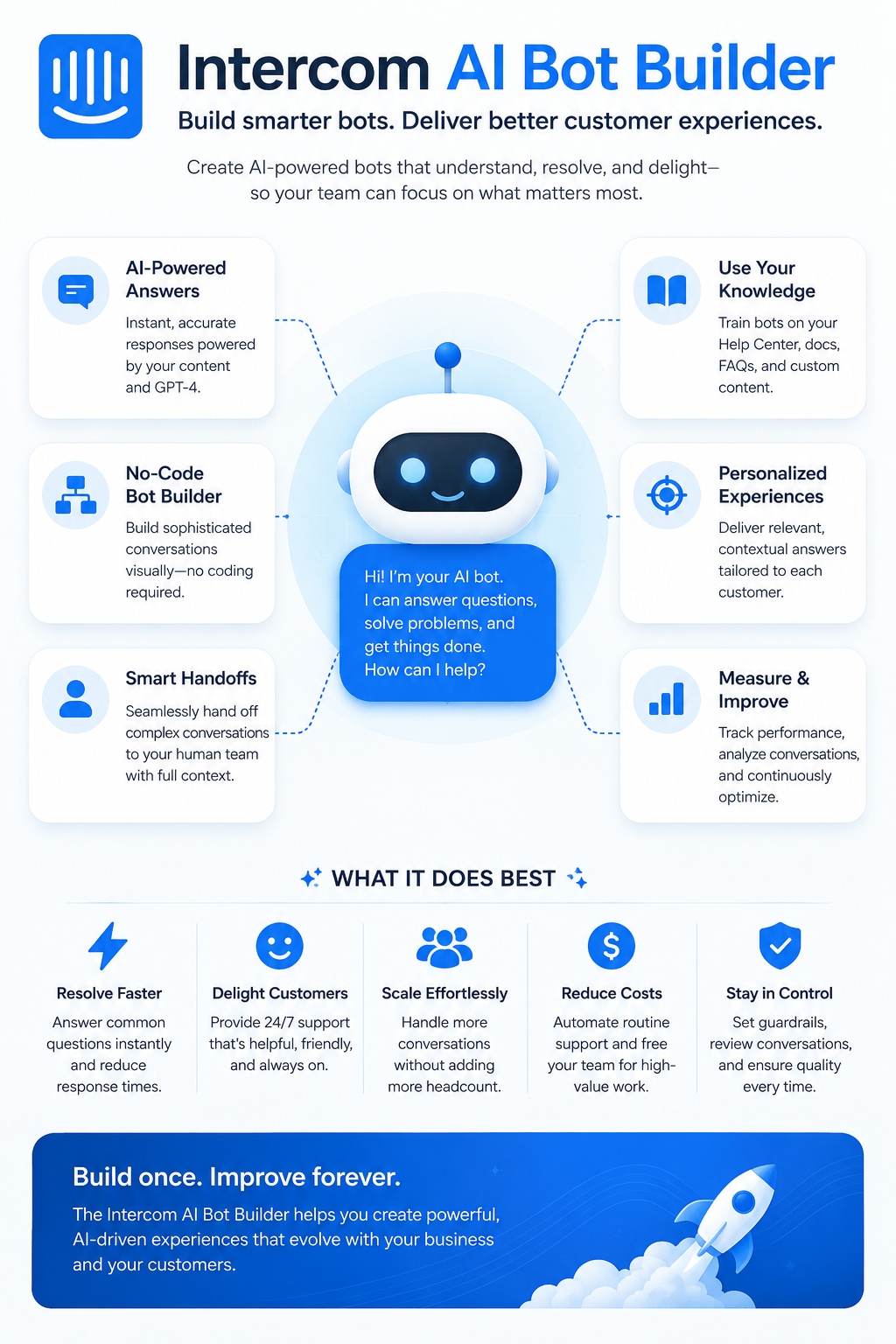
What Intercom Bot Builder Does Best
In modern customer service, speed, consistency, and personalization have become essential. Customers expect businesses to respond quickly, understand their questions, and solve problems without forcing them through complicated menus or making them repeat information to multiple support agents. At the same time, businesses need to manage growing volumes of conversations without allowing support costs to rise at the same rate. This is where Intercom’s AI-powered bot-building capabilities stand out.
Although Intercom has traditionally been associated with chat and customer-support automation, its current AI approach goes considerably further than the traditional idea of a chatbot. Intercom’s Fin AI Agent is designed to understand customer intent, use a company’s knowledge and data, take actions, and involve human agents when necessary. Intercom describes Fin as a Customer Agent that can operate across service, sales, and ecommerce rather than simply answering scripted questions.
The greatest strength of Intercom’s bot builder, therefore, is not simply that it can create a bot. Its real strength is that it helps businesses build automated customer experiences that can understand, respond, act, learn, and escalate. In other words, it moves customer support automation from a collection of rigid decision trees toward a more intelligent conversational system.
1. Creating intelligent conversations without traditional coding
One of the most important things Intercom does well is make sophisticated customer-service automation accessible to teams that may not have dedicated developers.
Traditional bots often require businesses to construct large decision trees manually. A company might have to anticipate every possible way a customer could phrase a question, create buttons for each option, and manually connect each path to the appropriate answer. This can work for very simple situations, but it becomes increasingly difficult as the number of customer questions grows.
Intercom takes a more flexible approach. Its AI Agent can be configured, trained, tested, deployed, and analyzed within the Intercom environment, with Intercom specifically describing this process as requiring no code.
This matters because customer-service teams understand their customers better than most software developers do. A support manager should be able to define how an AI agent behaves, what information it should use, what situations require escalation, and what tone it should adopt without having to turn every change into an engineering project.
The result is a much shorter distance between identifying a support problem and automating its solution.
2. Turning existing company knowledge into useful answers
Another area where Intercom performs particularly well is knowledge utilization.
A customer-service bot is only as useful as the information available to it. A beautifully designed chatbot that does not know a company's policies, products, procedures, pricing, or frequently asked questions will quickly become frustrating for customers.
Intercom's Knowledge system is designed to centralize the content that powers AI agents, human agents, and self-service support. Businesses can create content directly in Intercom or bring information in from external sources.
This gives the bot a valuable foundation.
Instead of asking a company to create a completely separate database specifically for its chatbot, Intercom can use existing support knowledge. Help-center articles, documentation, FAQs, and other approved information can become part of the system that powers customer conversations.
This is one of the most practical advantages of an AI bot builder: the business does not have to start from zero.
Imagine a software company with hundreds of help articles. Customers might ask questions such as:
- “How do I reset my password?”
- “Why was my payment declined?”
- “Can I change my subscription?”
- “How do I invite another team member?”
- “Where can I download my invoice?”
A traditional chatbot might require separate flows for each question. An AI-powered system can instead interpret the customer's intent and find relevant information from the company's knowledge base.
That makes the experience feel less like navigating a menu and more like talking to an informed support representative.
3. Understanding natural language and messy customer questions
Customers rarely communicate in perfectly structured language.
A customer might type, “I can't login,” while another says, “My password isn't working,” and another writes, “I've been locked out of my account.” These messages may refer to the same underlying problem even though they contain different words.
This is one of the fundamental advantages of AI-based conversational systems.
Intercom says Fin is designed to understand what customers actually mean rather than being restricted to pre-planned scripted questions. Its system is intended to interpret natural-language requests, maintain context, and work toward resolving the underlying issue.
This capability makes the conversation more natural.
The customer does not need to learn how the company's bot works. Instead, the bot attempts to understand the customer's language.
That distinction is extremely important. The best customer-service automation is invisible. Customers should not have to think, “Which button should I press?” They should be able to describe their problem in ordinary language and receive a relevant response.
4. Going beyond answers to actually resolving problems
Perhaps the biggest difference between a basic chatbot and Intercom's current AI Agent approach is the emphasis on resolution rather than conversation.
A conventional chatbot may answer a question such as, “What is your refund policy?” But answering the question is not necessarily the same as solving the customer's problem.
Intercom positions Fin as an AI agent that can take action as part of resolving customer requests. Its current product messaging emphasizes that Fin can understand intent, maintain context, and take action rather than merely generating replies.
This is a major evolution in customer-support automation.
Consider a customer who wants to cancel a subscription. A basic chatbot might display a cancellation policy and tell the customer where to go. A more capable agent can potentially guide the customer through the process, follow the company's rules, and involve a human when approval or judgment is required.
The difference is simple:
A chatbot answers questions. An effective AI agent helps complete jobs.
That distinction is arguably what Intercom does best.
5. Automating repetitive support work
Customer-service teams spend a significant amount of time answering repetitive questions. Password problems, account questions, billing inquiries, product instructions, shipping questions, and basic troubleshooting can consume enormous amounts of agent time.
Automating these conversations gives human agents more time for work that genuinely requires human judgment.
Intercom reports that Fin resolves an average of 76% of customer queries, although actual results will vary considerably depending on the business, content quality, configuration, and types of conversations involved.
The important point is not simply the percentage. It is the operating model behind it.
If an AI agent can successfully handle thousands of routine conversations, a human support team can concentrate on complicated cases. Agents can spend more time on situations involving negotiation, empathy, unusual technical problems, account-specific decisions, or sensitive circumstances.
Automation therefore becomes more than a cost-cutting exercise. It can change the nature of the support team's work.
6. Providing support around the clock
Another major strength is availability.
Human support teams have working hours, shifts, holidays, vacations, and staffing constraints. An AI agent can remain available continuously.
For international businesses, this can be especially valuable. Customers may live in different time zones and expect help when it is convenient for them rather than when a support team happens to be online.
Intercom describes Fin as providing 24/7 customer service and supporting multiple languages and channels.
This creates an important customer-experience advantage.
A customer encountering a problem at midnight does not necessarily want to wait until the following morning simply to ask a basic question. If the AI agent can solve the problem immediately, the customer gets a faster experience and the company avoids unnecessary overnight queues.
7. Knowing when to involve a human
One of the most important characteristics of a good customer-service bot is knowing its limitations.
Automation becomes dangerous when an AI system attempts to handle situations that require human judgment. Intercom therefore places considerable emphasis on human handoff and configurable escalation.
Fin can be configured to transfer conversations to human agents under specified conditions, and Intercom says it automatically hands off when it detects certain high-risk situations.
This is critical because the goal should not be to eliminate humans from customer service.
The goal should be to use humans where humans add the most value.
A good model looks like this:
AI handles the predictable.
AI assists with the complicated.
Humans handle the sensitive and exceptional.
The handoff experience also matters. Intercom says that when Fin transfers a conversation, the human agent can receive the conversation history and context, reducing the need for the customer to explain the entire situation again.
That creates a much smoother transition between automation and human service.
8. Personalizing customer interactions
Another area where Intercom's approach is powerful is personalization.
Customers do not want generic answers if the company already has information that could make the interaction more relevant. Context can include previous conversations, customer information, audience attributes, product usage, or the customer's current situation.
Intercom's AI system can use available customer context and audience targeting to determine when and how Fin interacts with customers. Intercom also states that Fin can respect audience targeting applied to Intercom content.
Personalization makes automated support feel less mechanical.
Instead of responding to every customer as an anonymous visitor, an AI agent can operate within the context available to the business.
This is especially valuable for SaaS companies, ecommerce businesses, subscription services, financial platforms, and other companies where customers have different accounts, products, plans, or histories.
9. Supporting multiple customer-facing roles
Intercom's current vision for Fin goes beyond traditional support.
Intercom describes Fin as a unified Customer Agent that can operate in roles such as service, sales, and ecommerce. In service, it resolves customer issues; in sales, it can engage prospects, qualify leads, and guide them toward meetings or sign-ups; and in ecommerce, it can act as a shopping assistant.
This is significant because the same customer may interact with a company at multiple stages of their journey.
Someone might first visit a website as a prospective buyer, later become a customer, and eventually need technical support. Instead of treating each interaction as completely separate, an AI-agent approach can create a more connected experience.
This is one of the strongest long-term ideas behind Intercom's bot-building strategy: automation does not have to be limited to a single support question.
It can participate in the broader customer journey.
10. Connecting automation to workflows and business systems
A powerful bot is not isolated from the rest of the company.
Customer support frequently involves other systems: CRM platforms, payment services, project-management tools, ecommerce systems, internal databases, and other applications.
Intercom states that its platform connects with hundreds of tools and provides integrations and APIs for extending its capabilities.
This matters because many customer requests require information or actions outside the conversation itself.
For example, a customer might ask about an order, subscription, payment, or account. The most useful automated experience is one that can work with the relevant systems rather than simply responding with a generic instruction.
Intercom's Workflows also provide a way to build automation for routing conversations, managing processes, and triggering actions.
The result is a broader automation environment rather than a standalone chat window.
11. Testing before deployment
A major advantage of treating an AI bot as a system rather than a simple script is the ability to test it before exposing it to customers.
Intercom describes a process in which teams can train, test, deploy, and analyze Fin from the same environment.
Testing is particularly important for AI because AI responses are not always as predictable as traditional decision-tree responses.
A business should be able to ask:
- Does the bot understand common questions?
- Does it use the right knowledge?
- Does it follow our policies?
- Does it know when to escalate?
- Does it use the correct tone?
- Does it avoid making unsupported claims?
- Does it handle unusual questions appropriately?
The ability to test and refine the system before and after deployment helps reduce the risk associated with customer-facing automation.
12. Continuous improvement through analytics
The best automation systems are not static.
Customer questions change. Products change. Policies change. New problems emerge. Some answers become outdated. Some conversations expose gaps in the company's knowledge base.
Intercom's AI analytics are designed to help teams monitor performance, identify gaps, and improve the AI agent over time. Intercom says its insights can monitor Fin's performance and identify opportunities to improve content and actions.
This creates an important feedback loop.
A simplified version looks like:
Customer asks → AI responds → conversation is measured → weaknesses are identified → knowledge or guidance is improved → AI performs better.
This continuous cycle may ultimately be more important than the initial bot setup.
Building a bot once is easy compared with maintaining an excellent automated customer experience over months and years.
13. Giving businesses control over the AI experience
Another area where Intercom's bot builder is strong is control.
Businesses need automation, but they also need boundaries.
Intercom allows teams to configure aspects of Fin's behavior, including tone, answer length, actions, routing, and escalation.
That means companies can decide not only what the AI knows, but also how it should behave.
This is particularly important for organizations with strict policies or regulated customer interactions.
The company can establish rules around what the AI should answer, what it should avoid, when it should request human involvement, and how it should communicate.
In practice, this turns the bot from a generic AI assistant into a company-specific customer-service representative.
14. Creating consistency at scale
Human agents are capable of delivering exceptional service, but maintaining perfect consistency across hundreds or thousands of conversations is difficult.
Different agents may interpret policies differently. Some may respond faster than others. Some may have more product knowledge. Some may be working under heavy workloads.
AI can provide a consistent baseline.
If the knowledge base and guidance are properly configured, the same core information can be available to customers regardless of the time of day or which support channel they use.
Consistency is especially important for growing companies.
A business that receives 100 support conversations per day may be able to manage them manually. A business receiving 10,000 conversations per day needs a fundamentally different operating model.
This is where automation becomes a scalability tool.
15. Improving the economics of customer support
Cost reduction is an obvious benefit of automation, but it should not be viewed as the only objective.
The real economic advantage is leverage.
If an AI agent can handle a large proportion of routine interactions, a company can increase its support capacity without necessarily increasing its human workforce at the same rate.
Intercom currently charges Fin based on outcomes, with its pricing documentation stating a starting price of $0.99 per Fin outcome on its current plans.
The economics will differ from company to company, but the underlying concept is straightforward: automation can allow a support organization to handle more customer interactions with fewer repetitive human interventions.
That can reduce costs, but it can also allow businesses to invest their human resources in higher-value activities.
16. What Intercom Bot Builder does best
When all of these capabilities are considered together, several core strengths become clear.
It does best at turning knowledge into conversations.
Businesses already have enormous amounts of information. Intercom provides a way to make that information accessible through natural-language interactions.
It does best at automating repetitive customer support.
Routine questions can be answered without requiring a human agent to intervene every time.
It does best at moving from answers toward resolutions.
The important objective is not simply producing text. The system is designed to understand intent, take appropriate actions, and help complete customer requests.
It does best at combining AI with human support.
Rather than forcing companies to choose between humans and automation, Intercom creates a model in which the AI handles appropriate work and humans take over when their expertise is needed.
It does best at scaling customer conversations.
Businesses can support more customers across more channels without relying exclusively on expanding their human support teams.
It does best at creating a continuous improvement loop.
Testing, analytics, knowledge management, and performance monitoring allow businesses to refine the experience over time.
Conclusion
Intercom's Bot Builder, viewed through the company's current Fin AI Agent and automation ecosystem, is best understood not as a tool for making simple chatbots but as a platform for creating intelligent customer-service experiences.
Its greatest strength is the combination of several capabilities that traditionally existed separately: conversational AI, company knowledge, automation, customer context, workflows, human escalation, analytics, and continuous improvement.
The most impressive part is the shift from “What can the bot say?” to “What can the bot help the customer accomplish?”
That difference changes everything.
A basic chatbot can tell a customer where to find an answer. A sophisticated AI agent can understand what the customer is trying to achieve, retrieve the appropriate information, follow company rules, take relevant actions, and bring in a human when necessary. Intercom's current Fin product is explicitly built around this broader concept of resolution rather than simple question answering.
For customers, this can mean faster and more convenient support. For support teams, it can mean fewer repetitive conversations and more time for complex cases. For businesses, it can mean greater scalability and a more efficient support operation.
Ultimately, what Intercom does best is make sophisticated customer-service automation practical. It allows businesses to combine the speed and availability of AI with the knowledge, judgment, and empathy of human teams. When properly configured and
In modern customer service, speed, consistency, and personalization have become essential. Customers expect businesses to respond quickly, understand their questions, and solve problems without forcing them through complicated menus or making them repeat information to multiple support agents. At the same time, businesses need to manage growing volumes of conversations without allowing support costs to rise at the same rate. This is where Intercom’s AI-powered bot-building capabilities stand out.
Although Intercom has traditionally been associated with chat and customer-support automation, its current AI approach goes considerably further than the traditional idea of a chatbot. Intercom’s Fin AI Agent is designed to understand customer intent, use a company’s knowledge and data, take actions, and involve human agents when necessary. Intercom describes Fin as a Customer Agent that can operate across service, sales, and ecommerce rather than simply answering scripted questions.
The greatest strength of Intercom’s bot builder, therefore, is not simply that it can create a bot. Its real strength is that it helps businesses build automated customer experiences that can understand, respond, act, learn, and escalate. In other words, it moves customer support automation from a collection of rigid decision trees toward a more intelligent conversational system.
1. Creating intelligent conversations without traditional coding
One of the most important things Intercom does well is make sophisticated customer-service automation accessible to teams that may not have dedicated developers.
Traditional bots often require businesses to construct large decision trees manually. A company might have to anticipate every possible way a customer could phrase a question, create buttons for each option, and manually connect each path to the appropriate answer. This can work for very simple situations, but it becomes increasingly difficult as the number of customer questions grows.
Intercom takes a more flexible approach. Its AI Agent can be configured, trained, tested, deployed, and analyzed within the Intercom environment, with Intercom specifically describing this process as requiring no code.
This matters because customer-service teams understand their customers better than most software developers do. A support manager should be able to define how an AI agent behaves, what information it should use, what situations require escalation, and what tone it should adopt without having to turn every change into an engineering project.
The result is a much shorter distance between identifying a support problem and automating its solution.
2. Turning existing company knowledge into useful answers
Another area where Intercom performs particularly well is knowledge utilization.
A customer-service bot is only as useful as the information available to it. A beautifully designed chatbot that does not know a company's policies, products, procedures, pricing, or frequently asked questions will quickly become frustrating for customers.
Intercom's Knowledge system is designed to centralize the content that powers AI agents, human agents, and self-service support. Businesses can create content directly in Intercom or bring information in from external sources.
This gives the bot a valuable foundation.
Instead of asking a company to create a completely separate database specifically for its chatbot, Intercom can use existing support knowledge. Help-center articles, documentation, FAQs, and other approved information can become part of the system that powers customer conversations.
This is one of the most practical advantages of an AI bot builder: the business does not have to start from zero.
Imagine a software company with hundreds of help articles. Customers might ask questions such as:
- “How do I reset my password?”
- “Why was my payment declined?”
- “Can I change my subscription?”
- “How do I invite another team member?”
- “Where can I download my invoice?”
A traditional chatbot might require separate flows for each question. An AI-powered system can instead interpret the customer's intent and find relevant information from the company's knowledge base.
That makes the experience feel less like navigating a menu and more like talking to an informed support representative.
3. Understanding natural language and messy customer questions
Customers rarely communicate in perfectly structured language.
A customer might type, “I can't login,” while another says, “My password isn't working,” and another writes, “I've been locked out of my account.” These messages may refer to the same underlying problem even though they contain different words.
This is one of the fundamental advantages of AI-based conversational systems.
Intercom says Fin is designed to understand what customers actually mean rather than being restricted to pre-planned scripted questions. Its system is intended to interpret natural-language requests, maintain context, and work toward resolving the underlying issue.
This capability makes the conversation more natural.
The customer does not need to learn how the company's bot works. Instead, the bot attempts to understand the customer's language.
That distinction is extremely important. The best customer-service automation is invisible. Customers should not have to think, “Which button should I press?” They should be able to describe their problem in ordinary language and receive a relevant response.
4. Going beyond answers to actually resolving problems
Perhaps the biggest difference between a basic chatbot and Intercom's current AI Agent approach is the emphasis on resolution rather than conversation.
A conventional chatbot may answer a question such as, “What is your refund policy?” But answering the question is not necessarily the same as solving the customer's problem.
Intercom positions Fin as an AI agent that can take action as part of resolving customer requests. Its current product messaging emphasizes that Fin can understand intent, maintain context, and take action rather than merely generating replies.
This is a major evolution in customer-support automation.
Consider a customer who wants to cancel a subscription. A basic chatbot might display a cancellation policy and tell the customer where to go. A more capable agent can potentially guide the customer through the process, follow the company's rules, and involve a human when approval or judgment is required.
The difference is simple:
A chatbot answers questions. An effective AI agent helps complete jobs.
That distinction is arguably what Intercom does best.
5. Automating repetitive support work
Customer-service teams spend a significant amount of time answering repetitive questions. Password problems, account questions, billing inquiries, product instructions, shipping questions, and basic troubleshooting can consume enormous amounts of agent time.
Automating these conversations gives human agents more time for work that genuinely requires human judgment.
Intercom reports that Fin resolves an average of 76% of customer queries, although actual results will vary considerably depending on the business, content quality, configuration, and types of conversations involved.
The important point is not simply the percentage. It is the operating model behind it.
If an AI agent can successfully handle thousands of routine conversations, a human support team can concentrate on complicated cases. Agents can spend more time on situations involving negotiation, empathy, unusual technical problems, account-specific decisions, or sensitive circumstances.
Automation therefore becomes more than a cost-cutting exercise. It can change the nature of the support team's work.
6. Providing support around the clock
Another major strength is availability.
Human support teams have working hours, shifts, holidays, vacations, and staffing constraints. An AI agent can remain available continuously.
For international businesses, this can be especially valuable. Customers may live in different time zones and expect help when it is convenient for them rather than when a support team happens to be online.
Intercom describes Fin as providing 24/7 customer service and supporting multiple languages and channels.
This creates an important customer-experience advantage.
A customer encountering a problem at midnight does not necessarily want to wait until the following morning simply to ask a basic question. If the AI agent can solve the problem immediately, the customer gets a faster experience and the company avoids unnecessary overnight queues.
7. Knowing when to involve a human
One of the most important characteristics of a good customer-service bot is knowing its limitations.
Automation becomes dangerous when an AI system attempts to handle situations that require human judgment. Intercom therefore places considerable emphasis on human handoff and configurable escalation.
Fin can be configured to transfer conversations to human agents under specified conditions, and Intercom says it automatically hands off when it detects certain high-risk situations.
This is critical because the goal should not be to eliminate humans from customer service.
The goal should be to use humans where humans add the most value.
A good model looks like this:
AI handles the predictable.
AI assists with the complicated.
Humans handle the sensitive and exceptional.
The handoff experience also matters. Intercom says that when Fin transfers a conversation, the human agent can receive the conversation history and context, reducing the need for the customer to explain the entire situation again.
That creates a much smoother transition between automation and human service.
8. Personalizing customer interactions
Another area where Intercom's approach is powerful is personalization.
Customers do not want generic answers if the company already has information that could make the interaction more relevant. Context can include previous conversations, customer information, audience attributes, product usage, or the customer's current situation.
Intercom's AI system can use available customer context and audience targeting to determine when and how Fin interacts with customers. Intercom also states that Fin can respect audience targeting applied to Intercom content.
Personalization makes automated support feel less mechanical.
Instead of responding to every customer as an anonymous visitor, an AI agent can operate within the context available to the business.
This is especially valuable for SaaS companies, ecommerce businesses, subscription services, financial platforms, and other companies where customers have different accounts, products, plans, or histories.
9. Supporting multiple customer-facing roles
Intercom's current vision for Fin goes beyond traditional support.
Intercom describes Fin as a unified Customer Agent that can operate in roles such as service, sales, and ecommerce. In service, it resolves customer issues; in sales, it can engage prospects, qualify leads, and guide them toward meetings or sign-ups; and in ecommerce, it can act as a shopping assistant.
This is significant because the same customer may interact with a company at multiple stages of their journey.
Someone might first visit a website as a prospective buyer, later become a customer, and eventually need technical support. Instead of treating each interaction as completely separate, an AI-agent approach can create a more connected experience.
This is one of the strongest long-term ideas behind Intercom's bot-building strategy: automation does not have to be limited to a single support question.
It can participate in the broader customer journey.
10. Connecting automation to workflows and business systems
A powerful bot is not isolated from the rest of the company.
Customer support frequently involves other systems: CRM platforms, payment services, project-management tools, ecommerce systems, internal databases, and other applications.
Intercom states that its platform connects with hundreds of tools and provides integrations and APIs for extending its capabilities.
This matters because many customer requests require information or actions outside the conversation itself.
For example, a customer might ask about an order, subscription, payment, or account. The most useful automated experience is one that can work with the relevant systems rather than simply responding with a generic instruction.
Intercom's Workflows also provide a way to build automation for routing conversations, managing processes, and triggering actions.
The result is a broader automation environment rather than a standalone chat window.
11. Testing before deployment
A major advantage of treating an AI bot as a system rather than a simple script is the ability to test it before exposing it to customers.
Intercom describes a process in which teams can train, test, deploy, and analyze Fin from the same environment.
Testing is particularly important for AI because AI responses are not always as predictable as traditional decision-tree responses.
A business should be able to ask:
- Does the bot understand common questions?
- Does it use the right knowledge?
- Does it follow our policies?
- Does it know when to escalate?
- Does it use the correct tone?
- Does it avoid making unsupported claims?
- Does it handle unusual questions appropriately?
The ability to test and refine the system before and after deployment helps reduce the risk associated with customer-facing automation.
12. Continuous improvement through analytics
The best automation systems are not static.
Customer questions change. Products change. Policies change. New problems emerge. Some answers become outdated. Some conversations expose gaps in the company's knowledge base.
Intercom's AI analytics are designed to help teams monitor performance, identify gaps, and improve the AI agent over time. Intercom says its insights can monitor Fin's performance and identify opportunities to improve content and actions.
This creates an important feedback loop.
A simplified version looks like:
Customer asks → AI responds → conversation is measured → weaknesses are identified → knowledge or guidance is improved → AI performs better.
This continuous cycle may ultimately be more important than the initial bot setup.
Building a bot once is easy compared with maintaining an excellent automated customer experience over months and years.
13. Giving businesses control over the AI experience
Another area where Intercom's bot builder is strong is control.
Businesses need automation, but they also need boundaries.
Intercom allows teams to configure aspects of Fin's behavior, including tone, answer length, actions, routing, and escalation.
That means companies can decide not only what the AI knows, but also how it should behave.
This is particularly important for organizations with strict policies or regulated customer interactions.
The company can establish rules around what the AI should answer, what it should avoid, when it should request human involvement, and how it should communicate.
In practice, this turns the bot from a generic AI assistant into a company-specific customer-service representative.
14. Creating consistency at scale
Human agents are capable of delivering exceptional service, but maintaining perfect consistency across hundreds or thousands of conversations is difficult.
Different agents may interpret policies differently. Some may respond faster than others. Some may have more product knowledge. Some may be working under heavy workloads.
AI can provide a consistent baseline.
If the knowledge base and guidance are properly configured, the same core information can be available to customers regardless of the time of day or which support channel they use.
Consistency is especially important for growing companies.
A business that receives 100 support conversations per day may be able to manage them manually. A business receiving 10,000 conversations per day needs a fundamentally different operating model.
This is where automation becomes a scalability tool.
15. Improving the economics of customer support
Cost reduction is an obvious benefit of automation, but it should not be viewed as the only objective.
The real economic advantage is leverage.
If an AI agent can handle a large proportion of routine interactions, a company can increase its support capacity without necessarily increasing its human workforce at the same rate.
Intercom currently charges Fin based on outcomes, with its pricing documentation stating a starting price of $0.99 per Fin outcome on its current plans.
The economics will differ from company to company, but the underlying concept is straightforward: automation can allow a support organization to handle more customer interactions with fewer repetitive human interventions.
That can reduce costs, but it can also allow businesses to invest their human resources in higher-value activities.
16. What Intercom Bot Builder does best
When all of these capabilities are considered together, several core strengths become clear.
It does best at turning knowledge into conversations.
Businesses already have enormous amounts of information. Intercom provides a way to make that information accessible through natural-language interactions.
It does best at automating repetitive customer support.
Routine questions can be answered without requiring a human agent to intervene every time.
It does best at moving from answers toward resolutions.
The important objective is not simply producing text. The system is designed to understand intent, take appropriate actions, and help complete customer requests.
It does best at combining AI with human support.
Rather than forcing companies to choose between humans and automation, Intercom creates a model in which the AI handles appropriate work and humans take over when their expertise is needed.
It does best at scaling customer conversations.
Businesses can support more customers across more channels without relying exclusively on expanding their human support teams.
It does best at creating a continuous improvement loop.
Testing, analytics, knowledge management, and performance monitoring allow businesses to refine the experience over time.
Conclusion
Intercom's Bot Builder, viewed through the company's current Fin AI Agent and automation ecosystem, is best understood not as a tool for making simple chatbots but as a platform for creating intelligent customer-service experiences.
Its greatest strength is the combination of several capabilities that traditionally existed separately: conversational AI, company knowledge, automation, customer context, workflows, human escalation, analytics, and continuous improvement.
The most impressive part is the shift from “What can the bot say?” to “What can the bot help the customer accomplish?”
That difference changes everything.
A basic chatbot can tell a customer where to find an answer. A sophisticated AI agent can understand what the customer is trying to achieve, retrieve the appropriate information, follow company rules, take relevant actions, and bring in a human when necessary. Intercom's current Fin product is explicitly built around this broader concept of resolution rather than simple question answering.
For customers, this can mean faster and more convenient support. For support teams, it can mean fewer repetitive conversations and more time for complex cases. For businesses, it can mean greater scalability and a more efficient support operation.
Ultimately, what Intercom does best is make sophisticated customer-service automation practical. It allows businesses to combine the speed and availability of AI with the knowledge, judgment, and empathy of human teams. When properly configured and