What Landbot does best

Martins Aligwe
August 21, 2026
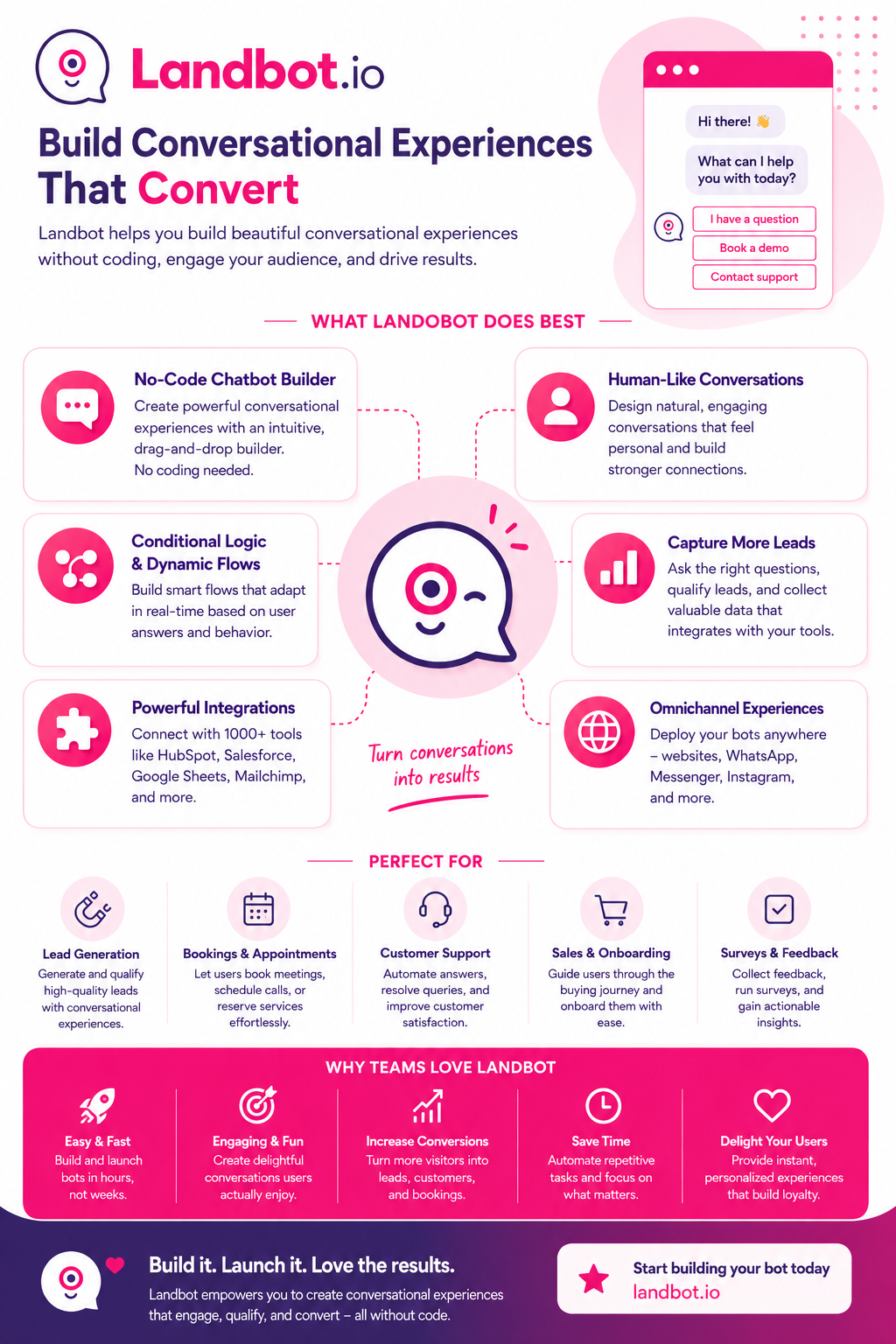
What Landbot Bot Builder Does Best
In a digital economy where customers expect immediate answers, businesses are under increasing pressure to create experiences that are fast, personalized, engaging, and scalable. Traditional website forms, email-based processes, and rigid customer-service systems can often feel disconnected from the way people actually want to interact with businesses. Customers increasingly expect to communicate naturally, receive immediate responses, and complete tasks without unnecessary friction.
This is where Landbot Bot Builder stands out.
Landbot is fundamentally a no-code conversational platform designed to help businesses build interactive experiences for the web, WhatsApp, Facebook Messenger, and other channels through APIs. It supports both rule-based chatbots and AI Agents, allowing businesses to combine predictable workflows with more flexible AI-powered conversations.
What Landbot does best is not simply "build chatbots." Its strongest capability is turning ordinary business processes into interactive conversations.
Instead of asking customers to fill out a long static form, Landbot can guide them through a conversation. Instead of sending visitors to different pages to find information, it can bring the relevant questions and answers directly into the interaction. Instead of collecting leads and manually sorting them later, it can qualify people during the conversation and route valuable information into the company's sales or marketing systems.
The result is a different kind of customer experience: one that feels interactive, responsive, and personalized.
1. Landbot excels at no-code conversational building
Perhaps Landbot's most recognizable strength is its visual, no-code builder.
Traditional software development can require developers to design interfaces, write logic, connect databases, test applications, and deploy updates. For a marketing or sales team that wants to experiment with a new customer journey, this can create significant delays.
Landbot takes much of that complexity away.
Its visual builder allows users to construct conversations using blocks, connections, conditions, questions, messages, integrations, and other components. Landbot describes the builder as a drag-and-drop environment that supports conditional logic, formulas, rich media, variables, and dynamic data.
This visual approach is important because conversational experiences are fundamentally about flows.
A business might want a visitor to:
1. Start a conversation.
2. Choose what they need.
3. Answer several questions.
4. Provide their contact details.
5. Become qualified according to specific criteria.
6. Book an appointment.
7. Receive a confirmation.
8. Be transferred to a human if necessary.
In a traditional programming environment, building this process could require significant technical work. In Landbot, the flow can be represented visually.
The advantage is not only ease of use. It is visibility.
A marketer can look at the canvas and understand how the conversation works. A sales manager can identify where leads are being qualified. A support manager can see where customers are being routed. A business owner can make changes without necessarily waiting for a developer.
That makes Landbot particularly effective for teams that want to move quickly.
2. Landbot is exceptionally good at turning forms into conversations
One of the clearest use cases for Landbot is replacing static forms with conversational experiences.
A traditional form might say:
Name:
Email:
Company:
Phone:
Budget:
Message:
The customer sees a list of fields and is expected to complete everything before anything happens.
Landbot can approach the same process conversationally.
Instead of presenting six fields simultaneously, the experience can ask one question at a time:
«"Hi! What are you looking for?"»
The visitor chooses an answer.
«"Great. How large is your team?"»
The visitor responds.
«"Thanks. Would you like to schedule a conversation with our team?"»
The visitor books a meeting.
The underlying data collection may be similar, but the psychological experience is very different.
Landbot itself positions its conversational experiences as an alternative to static forms, particularly for lead generation. Its current lead-generation offering emphasizes interactive elements such as buttons, forms, carousels, and date pickers within conversations.
This is one of the platform's greatest strengths because conversations can make data collection feel like an interaction rather than an administrative task.
3. It does exceptionally well at lead generation and qualification
Landbot is particularly powerful for businesses whose primary objective is turning website visitors into qualified prospects.
A website can attract thousands of visitors, but traffic alone does not create revenue. Businesses need to identify which visitors are serious prospects, understand what they need, collect useful information, and connect high-intent prospects with sales teams.
Landbot can place that process directly inside a conversational experience.
The bot can ask qualification questions, collect contact details, segment users, and route information to other systems. Landbot specifically promotes AI-powered lead-generation workflows that qualify prospects and send high-intent leads to sales teams while nurturing or routing others differently.
This creates a major advantage for sales organizations.
Imagine a company selling enterprise software.
A visitor arrives on the website and starts a conversation. The bot could ask:
- What type of solution are you looking for?
- How many employees does your company have?
- What problem are you trying to solve?
- When are you looking to implement?
- Would you like a product demonstration?
Based on the answers, Landbot can create different paths.
A high-value enterprise prospect might be directed toward a sales representative.
A smaller prospect might receive self-service information.
A visitor who is still researching might receive educational resources.
The conversation therefore becomes a qualification mechanism rather than simply a communication channel.
4. Conditional logic is one of Landbot's biggest strengths
Another area where Landbot shines is conditional logic.
A good conversational experience should not treat every user identically.
If someone says they are already a customer, the conversation should probably be different from the conversation shown to a first-time visitor.
If someone wants technical support, they should not be sent through a sales journey.
If someone has a large budget and immediate purchasing intent, they may deserve a faster sales handoff.
Landbot's conditional logic allows conversations to branch according to information collected during the interaction. The platform describes conditional logic as a way to create different paths based on user input.
This gives businesses considerable control.
For example:
If customer = existing customer → support flow
If customer = new prospect → sales flow
If budget > threshold → priority sales flow
If appointment requested → booking flow
If question cannot be answered → human handoff
The result is a conversation that adapts to the individual rather than forcing everyone through the same script.
5. It combines structure with flexibility
One of Landbot's most interesting strengths is the ability to combine predictable workflows with AI.
Purely rule-based chatbots are reliable but can feel rigid. Purely generative AI can be flexible but may not always behave exactly as a business process requires.
Landbot allows businesses to combine both approaches.
Its documentation describes AI Agents that can collect and store user information, consult a knowledge base, and fit into rule-based bot flows.
This hybrid approach is powerful.
Consider a customer-support experience.
The business might want the AI to answer general questions naturally. But when the customer wants to request a refund, the company may require a specific process.
The AI can handle the conversational part, while structured workflow logic controls the business-critical steps.
This gives companies a useful balance:
AI provides flexibility.
Workflow logic provides control.
Integrations provide action.
Human handoff provides judgment.
That combination is one of Landbot's most compelling characteristics.
6. Landbot is strong at creating personalized experiences
Generic automation often feels generic because every customer receives the same response.
Landbot's variables, conditional logic, and dynamic data capabilities allow conversations to adapt to information collected during the interaction. The platform specifically highlights variables and formulas as mechanisms for storing information and using it within more sophisticated conversational flows.
For example, if the customer tells the bot their name, the bot can use it later.
If they select a product category, subsequent recommendations can reflect that selection.
If they identify themselves as an existing customer, the flow can change.
If an external system supplies customer information, the conversation can potentially become even more contextual.
This is what transforms a chatbot from a static script into a personalized digital experience.
7. It does a great job with interactive user interfaces
Landbot's visual nature is not limited to text.
The platform supports rich media and interactive elements, and its conversational experiences can include buttons, forms, carousels, date pickers, images, links, and other components.
This matters because conversation does not always have to mean typing.
Some customers prefer clicking.
Others want to select from a few choices.
Someone booking a meeting may want a calendar.
Someone choosing a product may want to browse visual options.
Someone submitting information may prefer a structured form.
Landbot can combine these interaction types within one experience.
That flexibility is one reason the platform can be used for considerably more than simple FAQ bots.
8. It is especially useful for WhatsApp automation
Landbot also has a strong position in conversational experiences on WhatsApp.
The company provides a dedicated WhatsApp solution that supports no-code flow building, opt-in collection, campaigns, notifications, testing, integrations, and human support.
This is significant because WhatsApp is fundamentally different from a website.
On a website, a business has control over the page environment.
On WhatsApp, the conversation takes place inside a messaging environment that customers already use.
That can make conversational automation more natural.
A company might use WhatsApp to:
- Answer customer questions.
- Capture leads.
- Send notifications.
- Conduct marketing campaigns.
- Provide customer support.
- Collect information.
- Schedule appointments.
- Follow up with prospects.
Landbot's ability to build and manage these experiences from a visual environment makes WhatsApp automation more accessible to nontechnical teams.
9. It connects conversations to business systems
A chatbot becomes much more valuable when it can do something with the information it collects.
Suppose a visitor provides their name, email address, company size, and purchasing requirements.
If that information remains trapped inside the chatbot, the business still has a manual process to complete.
But if the data can be sent to a CRM or another business application, the conversation becomes part of a larger workflow.
Landbot supports native integrations and can also connect to external systems through Webhooks and APIs. Its platform documentation lists integrations with tools such as Salesforce, Google Sheets, Stripe, Mailchimp, Calendly, Slack, and others, while its current platform also highlights connections with CRM and automation tools such as HubSpot, n8n, Zapier, and custom APIs.
This is a major strength.
The bot does not have to be the end of the process.
It can be the beginning of an automated business workflow.
For example:
Customer conversation → qualification → CRM record → sales notification → meeting booking → follow-up
That is far more valuable than:
Customer conversation → transcript
10. Landbot excels at appointment booking
Appointment booking is another natural application for conversational automation.
Rather than asking customers to find a separate booking page, a chatbot can guide them through the process.
For example:
«"Would you like to speak with our sales team?"»
Yes
«"What day works best for you?"»
The customer selects an option.
The system can then connect to a scheduling platform such as Calendly or another integrated system.
Landbot specifically identifies bookings and appointments as one of its use cases, alongside lead generation, customer support, and sales.
This reduces friction between interest and action.
For businesses where speed matters, that can be extremely valuable.
A potential customer who is ready to speak with sales should not have to navigate through several pages before finding a calendar.
The conversation can simply take them there.
11. It is powerful for customer support and FAQs
Although lead generation is a major strength, Landbot is not limited to marketing.
The platform supports customer-support use cases, including answering frequently asked questions and automating customer interactions.
A support bot can handle repetitive questions such as:
- What are your opening hours?
- Where is my order?
- How do I reset my password?
- What is your refund policy?
- How do I book a service?
- Which product is right for me?
The value is particularly high when the same questions are asked repeatedly.
Instead of having a human agent answer the same question hundreds of times, the chatbot can provide an immediate response.
And when automation reaches its limits, Landbot supports human takeover through its team inbox.
This creates a sensible division of labor between automation and people.
12. Human handoff makes the system more practical
The best chatbot is not necessarily the one that tries to solve everything.
There are situations where customers need a human.
A customer may have a complicated complaint. A sales prospect may request a negotiation. A technical issue may require investigation. A sensitive problem may require empathy and judgment.
Landbot supports moving conversations to human support and managing agents and chats through a central team inbox.
This means automation does not have to create a wall between the customer and the company.
Instead, the chatbot can serve as the first layer.
The customer begins with automation.
The system gathers information.
The bot handles what it can.
Then the conversation moves to a human when appropriate.
That is a much more practical model than trying to eliminate human interaction completely.
13. It gives businesses control over the customer journey
Another major advantage of Landbot is control.
Businesses can decide exactly how their conversations should work.
This is especially important in sales and marketing.
A company might want to ask qualification questions in a particular order.
It might want to present different offers to different customer segments.
It might want to require certain information before allowing a booking.
It might want to route customers according to geographic region.
It might want to show different product recommendations depending on previous answers.
Landbot's combination of variables, conditional logic, formulas, dynamic data, and integrations makes these types of experiences possible.
The business is therefore not simply deploying an AI model and hoping for the best.
It can design the structure around the AI.
That distinction is particularly important for organizations that care about predictable customer journeys.
14. It makes experimentation easier
Marketing teams constantly need to experiment.
Which opening message produces more engagement?
Which qualification question causes users to abandon the conversation?
Should a business ask for an email address early or later?
Does a shorter flow convert better?
Does a product recommendation improve sales?
Landbot's analytics and reporting capabilities allow teams to monitor goals, reports, and conversation drop-offs.
This allows businesses to treat their conversational experience as an optimization problem.
Instead of simply building a bot and leaving it unchanged, teams can observe how users behave and modify the flow.
The process becomes:
Build → launch → measure → identify friction → improve → repeat.
That iterative approach is essential to creating effective conversational experiences.
15. It is particularly effective for conversion-focused experiences
Landbot's strengths come together especially well when the goal is conversion.
A traditional website may ask a visitor to read several pages and eventually click "Contact Us."
A Landbot experience can actively engage that visitor.
It can ask what they need.
It can recommend a product.
It can answer questions.
It can identify their needs.
It can qualify them.
It can collect their contact details.
It can book an appointment.
It can pass the information to the sales team.
Landbot's current product positioning strongly emphasizes this conversion-oriented use case, describing its AI agents as tools for engaging visitors, qualifying them in real time, and handing sales-ready leads to teams.
This is where Landbot's conversational approach can have a direct commercial impact.
The conversation is not merely communication.
It becomes part of the conversion funnel.
16. It can make websites feel more human
Static websites are good at presenting information.
Conversational websites can respond to people.
That distinction is becoming increasingly important.
Imagine visiting a website for a complex software product. Instead of searching through menus and documentation, you can simply say:
«"I'm looking for software for a team of about 50 people, and we need CRM integration."»
A conversational system can respond to that specific requirement.
It can ask follow-up questions.
It can explain relevant features.
It can direct the visitor toward an appropriate product or sales conversation.
Landbot's platform is designed around precisely this type of interactive experience, with customizable web bots and AI-powered agents that can combine conversational interactions with structured workflows.
This is one of the most compelling aspects of the technology.
It changes a website from something customers simply read into something customers can interact with.
17. It supports both simple and sophisticated projects
Another reason Landbot is useful is its range.
A beginner can start with a template or use the "Build it for me" functionality, which allows users to describe what they want and have Landbot generate a draft workflow.
More advanced users can build flows manually and add conditional logic, formulas, variables, integrations, APIs, and customizations.
This creates a useful progression.
A beginner might start with:
Welcome → question → answer → contact form
An advanced team might create:
Visitor identification → CRM lookup → AI conversation → qualification → conditional routing → dynamic product recommendations → appointment booking → CRM update → sales notification
Both can exist within the same general platform.
That scalability of complexity is one of Landbot's strengths.
18. AI makes the builder even more accessible
Landbot has increasingly incorporated AI directly into the building process.
Its "Build It For Me" functionality allows a user to describe a desired chatbot in natural language and have Landbot generate a draft flow that can then be tested and customized.
The significance of this is easy to underestimate.
Previously,
In a digital economy where customers expect immediate answers, businesses are under increasing pressure to create experiences that are fast, personalized, engaging, and scalable. Traditional website forms, email-based processes, and rigid customer-service systems can often feel disconnected from the way people actually want to interact with businesses. Customers increasingly expect to communicate naturally, receive immediate responses, and complete tasks without unnecessary friction.
This is where Landbot Bot Builder stands out.
Landbot is fundamentally a no-code conversational platform designed to help businesses build interactive experiences for the web, WhatsApp, Facebook Messenger, and other channels through APIs. It supports both rule-based chatbots and AI Agents, allowing businesses to combine predictable workflows with more flexible AI-powered conversations.
What Landbot does best is not simply "build chatbots." Its strongest capability is turning ordinary business processes into interactive conversations.
Instead of asking customers to fill out a long static form, Landbot can guide them through a conversation. Instead of sending visitors to different pages to find information, it can bring the relevant questions and answers directly into the interaction. Instead of collecting leads and manually sorting them later, it can qualify people during the conversation and route valuable information into the company's sales or marketing systems.
The result is a different kind of customer experience: one that feels interactive, responsive, and personalized.
1. Landbot excels at no-code conversational building
Perhaps Landbot's most recognizable strength is its visual, no-code builder.
Traditional software development can require developers to design interfaces, write logic, connect databases, test applications, and deploy updates. For a marketing or sales team that wants to experiment with a new customer journey, this can create significant delays.
Landbot takes much of that complexity away.
Its visual builder allows users to construct conversations using blocks, connections, conditions, questions, messages, integrations, and other components. Landbot describes the builder as a drag-and-drop environment that supports conditional logic, formulas, rich media, variables, and dynamic data.
This visual approach is important because conversational experiences are fundamentally about flows.
A business might want a visitor to:
1. Start a conversation.
2. Choose what they need.
3. Answer several questions.
4. Provide their contact details.
5. Become qualified according to specific criteria.
6. Book an appointment.
7. Receive a confirmation.
8. Be transferred to a human if necessary.
In a traditional programming environment, building this process could require significant technical work. In Landbot, the flow can be represented visually.
The advantage is not only ease of use. It is visibility.
A marketer can look at the canvas and understand how the conversation works. A sales manager can identify where leads are being qualified. A support manager can see where customers are being routed. A business owner can make changes without necessarily waiting for a developer.
That makes Landbot particularly effective for teams that want to move quickly.
2. Landbot is exceptionally good at turning forms into conversations
One of the clearest use cases for Landbot is replacing static forms with conversational experiences.
A traditional form might say:
Name:
Email:
Company:
Phone:
Budget:
Message:
The customer sees a list of fields and is expected to complete everything before anything happens.
Landbot can approach the same process conversationally.
Instead of presenting six fields simultaneously, the experience can ask one question at a time:
«"Hi! What are you looking for?"»
The visitor chooses an answer.
«"Great. How large is your team?"»
The visitor responds.
«"Thanks. Would you like to schedule a conversation with our team?"»
The visitor books a meeting.
The underlying data collection may be similar, but the psychological experience is very different.
Landbot itself positions its conversational experiences as an alternative to static forms, particularly for lead generation. Its current lead-generation offering emphasizes interactive elements such as buttons, forms, carousels, and date pickers within conversations.
This is one of the platform's greatest strengths because conversations can make data collection feel like an interaction rather than an administrative task.
3. It does exceptionally well at lead generation and qualification
Landbot is particularly powerful for businesses whose primary objective is turning website visitors into qualified prospects.
A website can attract thousands of visitors, but traffic alone does not create revenue. Businesses need to identify which visitors are serious prospects, understand what they need, collect useful information, and connect high-intent prospects with sales teams.
Landbot can place that process directly inside a conversational experience.
The bot can ask qualification questions, collect contact details, segment users, and route information to other systems. Landbot specifically promotes AI-powered lead-generation workflows that qualify prospects and send high-intent leads to sales teams while nurturing or routing others differently.
This creates a major advantage for sales organizations.
Imagine a company selling enterprise software.
A visitor arrives on the website and starts a conversation. The bot could ask:
- What type of solution are you looking for?
- How many employees does your company have?
- What problem are you trying to solve?
- When are you looking to implement?
- Would you like a product demonstration?
Based on the answers, Landbot can create different paths.
A high-value enterprise prospect might be directed toward a sales representative.
A smaller prospect might receive self-service information.
A visitor who is still researching might receive educational resources.
The conversation therefore becomes a qualification mechanism rather than simply a communication channel.
4. Conditional logic is one of Landbot's biggest strengths
Another area where Landbot shines is conditional logic.
A good conversational experience should not treat every user identically.
If someone says they are already a customer, the conversation should probably be different from the conversation shown to a first-time visitor.
If someone wants technical support, they should not be sent through a sales journey.
If someone has a large budget and immediate purchasing intent, they may deserve a faster sales handoff.
Landbot's conditional logic allows conversations to branch according to information collected during the interaction. The platform describes conditional logic as a way to create different paths based on user input.
This gives businesses considerable control.
For example:
If customer = existing customer → support flow
If customer = new prospect → sales flow
If budget > threshold → priority sales flow
If appointment requested → booking flow
If question cannot be answered → human handoff
The result is a conversation that adapts to the individual rather than forcing everyone through the same script.
5. It combines structure with flexibility
One of Landbot's most interesting strengths is the ability to combine predictable workflows with AI.
Purely rule-based chatbots are reliable but can feel rigid. Purely generative AI can be flexible but may not always behave exactly as a business process requires.
Landbot allows businesses to combine both approaches.
Its documentation describes AI Agents that can collect and store user information, consult a knowledge base, and fit into rule-based bot flows.
This hybrid approach is powerful.
Consider a customer-support experience.
The business might want the AI to answer general questions naturally. But when the customer wants to request a refund, the company may require a specific process.
The AI can handle the conversational part, while structured workflow logic controls the business-critical steps.
This gives companies a useful balance:
AI provides flexibility.
Workflow logic provides control.
Integrations provide action.
Human handoff provides judgment.
That combination is one of Landbot's most compelling characteristics.
6. Landbot is strong at creating personalized experiences
Generic automation often feels generic because every customer receives the same response.
Landbot's variables, conditional logic, and dynamic data capabilities allow conversations to adapt to information collected during the interaction. The platform specifically highlights variables and formulas as mechanisms for storing information and using it within more sophisticated conversational flows.
For example, if the customer tells the bot their name, the bot can use it later.
If they select a product category, subsequent recommendations can reflect that selection.
If they identify themselves as an existing customer, the flow can change.
If an external system supplies customer information, the conversation can potentially become even more contextual.
This is what transforms a chatbot from a static script into a personalized digital experience.
7. It does a great job with interactive user interfaces
Landbot's visual nature is not limited to text.
The platform supports rich media and interactive elements, and its conversational experiences can include buttons, forms, carousels, date pickers, images, links, and other components.
This matters because conversation does not always have to mean typing.
Some customers prefer clicking.
Others want to select from a few choices.
Someone booking a meeting may want a calendar.
Someone choosing a product may want to browse visual options.
Someone submitting information may prefer a structured form.
Landbot can combine these interaction types within one experience.
That flexibility is one reason the platform can be used for considerably more than simple FAQ bots.
8. It is especially useful for WhatsApp automation
Landbot also has a strong position in conversational experiences on WhatsApp.
The company provides a dedicated WhatsApp solution that supports no-code flow building, opt-in collection, campaigns, notifications, testing, integrations, and human support.
This is significant because WhatsApp is fundamentally different from a website.
On a website, a business has control over the page environment.
On WhatsApp, the conversation takes place inside a messaging environment that customers already use.
That can make conversational automation more natural.
A company might use WhatsApp to:
- Answer customer questions.
- Capture leads.
- Send notifications.
- Conduct marketing campaigns.
- Provide customer support.
- Collect information.
- Schedule appointments.
- Follow up with prospects.
Landbot's ability to build and manage these experiences from a visual environment makes WhatsApp automation more accessible to nontechnical teams.
9. It connects conversations to business systems
A chatbot becomes much more valuable when it can do something with the information it collects.
Suppose a visitor provides their name, email address, company size, and purchasing requirements.
If that information remains trapped inside the chatbot, the business still has a manual process to complete.
But if the data can be sent to a CRM or another business application, the conversation becomes part of a larger workflow.
Landbot supports native integrations and can also connect to external systems through Webhooks and APIs. Its platform documentation lists integrations with tools such as Salesforce, Google Sheets, Stripe, Mailchimp, Calendly, Slack, and others, while its current platform also highlights connections with CRM and automation tools such as HubSpot, n8n, Zapier, and custom APIs.
This is a major strength.
The bot does not have to be the end of the process.
It can be the beginning of an automated business workflow.
For example:
Customer conversation → qualification → CRM record → sales notification → meeting booking → follow-up
That is far more valuable than:
Customer conversation → transcript
10. Landbot excels at appointment booking
Appointment booking is another natural application for conversational automation.
Rather than asking customers to find a separate booking page, a chatbot can guide them through the process.
For example:
«"Would you like to speak with our sales team?"»
Yes
«"What day works best for you?"»
The customer selects an option.
The system can then connect to a scheduling platform such as Calendly or another integrated system.
Landbot specifically identifies bookings and appointments as one of its use cases, alongside lead generation, customer support, and sales.
This reduces friction between interest and action.
For businesses where speed matters, that can be extremely valuable.
A potential customer who is ready to speak with sales should not have to navigate through several pages before finding a calendar.
The conversation can simply take them there.
11. It is powerful for customer support and FAQs
Although lead generation is a major strength, Landbot is not limited to marketing.
The platform supports customer-support use cases, including answering frequently asked questions and automating customer interactions.
A support bot can handle repetitive questions such as:
- What are your opening hours?
- Where is my order?
- How do I reset my password?
- What is your refund policy?
- How do I book a service?
- Which product is right for me?
The value is particularly high when the same questions are asked repeatedly.
Instead of having a human agent answer the same question hundreds of times, the chatbot can provide an immediate response.
And when automation reaches its limits, Landbot supports human takeover through its team inbox.
This creates a sensible division of labor between automation and people.
12. Human handoff makes the system more practical
The best chatbot is not necessarily the one that tries to solve everything.
There are situations where customers need a human.
A customer may have a complicated complaint. A sales prospect may request a negotiation. A technical issue may require investigation. A sensitive problem may require empathy and judgment.
Landbot supports moving conversations to human support and managing agents and chats through a central team inbox.
This means automation does not have to create a wall between the customer and the company.
Instead, the chatbot can serve as the first layer.
The customer begins with automation.
The system gathers information.
The bot handles what it can.
Then the conversation moves to a human when appropriate.
That is a much more practical model than trying to eliminate human interaction completely.
13. It gives businesses control over the customer journey
Another major advantage of Landbot is control.
Businesses can decide exactly how their conversations should work.
This is especially important in sales and marketing.
A company might want to ask qualification questions in a particular order.
It might want to present different offers to different customer segments.
It might want to require certain information before allowing a booking.
It might want to route customers according to geographic region.
It might want to show different product recommendations depending on previous answers.
Landbot's combination of variables, conditional logic, formulas, dynamic data, and integrations makes these types of experiences possible.
The business is therefore not simply deploying an AI model and hoping for the best.
It can design the structure around the AI.
That distinction is particularly important for organizations that care about predictable customer journeys.
14. It makes experimentation easier
Marketing teams constantly need to experiment.
Which opening message produces more engagement?
Which qualification question causes users to abandon the conversation?
Should a business ask for an email address early or later?
Does a shorter flow convert better?
Does a product recommendation improve sales?
Landbot's analytics and reporting capabilities allow teams to monitor goals, reports, and conversation drop-offs.
This allows businesses to treat their conversational experience as an optimization problem.
Instead of simply building a bot and leaving it unchanged, teams can observe how users behave and modify the flow.
The process becomes:
Build → launch → measure → identify friction → improve → repeat.
That iterative approach is essential to creating effective conversational experiences.
15. It is particularly effective for conversion-focused experiences
Landbot's strengths come together especially well when the goal is conversion.
A traditional website may ask a visitor to read several pages and eventually click "Contact Us."
A Landbot experience can actively engage that visitor.
It can ask what they need.
It can recommend a product.
It can answer questions.
It can identify their needs.
It can qualify them.
It can collect their contact details.
It can book an appointment.
It can pass the information to the sales team.
Landbot's current product positioning strongly emphasizes this conversion-oriented use case, describing its AI agents as tools for engaging visitors, qualifying them in real time, and handing sales-ready leads to teams.
This is where Landbot's conversational approach can have a direct commercial impact.
The conversation is not merely communication.
It becomes part of the conversion funnel.
16. It can make websites feel more human
Static websites are good at presenting information.
Conversational websites can respond to people.
That distinction is becoming increasingly important.
Imagine visiting a website for a complex software product. Instead of searching through menus and documentation, you can simply say:
«"I'm looking for software for a team of about 50 people, and we need CRM integration."»
A conversational system can respond to that specific requirement.
It can ask follow-up questions.
It can explain relevant features.
It can direct the visitor toward an appropriate product or sales conversation.
Landbot's platform is designed around precisely this type of interactive experience, with customizable web bots and AI-powered agents that can combine conversational interactions with structured workflows.
This is one of the most compelling aspects of the technology.
It changes a website from something customers simply read into something customers can interact with.
17. It supports both simple and sophisticated projects
Another reason Landbot is useful is its range.
A beginner can start with a template or use the "Build it for me" functionality, which allows users to describe what they want and have Landbot generate a draft workflow.
More advanced users can build flows manually and add conditional logic, formulas, variables, integrations, APIs, and customizations.
This creates a useful progression.
A beginner might start with:
Welcome → question → answer → contact form
An advanced team might create:
Visitor identification → CRM lookup → AI conversation → qualification → conditional routing → dynamic product recommendations → appointment booking → CRM update → sales notification
Both can exist within the same general platform.
That scalability of complexity is one of Landbot's strengths.
18. AI makes the builder even more accessible
Landbot has increasingly incorporated AI directly into the building process.
Its "Build It For Me" functionality allows a user to describe a desired chatbot in natural language and have Landbot generate a draft flow that can then be tested and customized.
The significance of this is easy to underestimate.
Previously,