Description of Chatfuel

Martins Aligwe
August 21, 2026
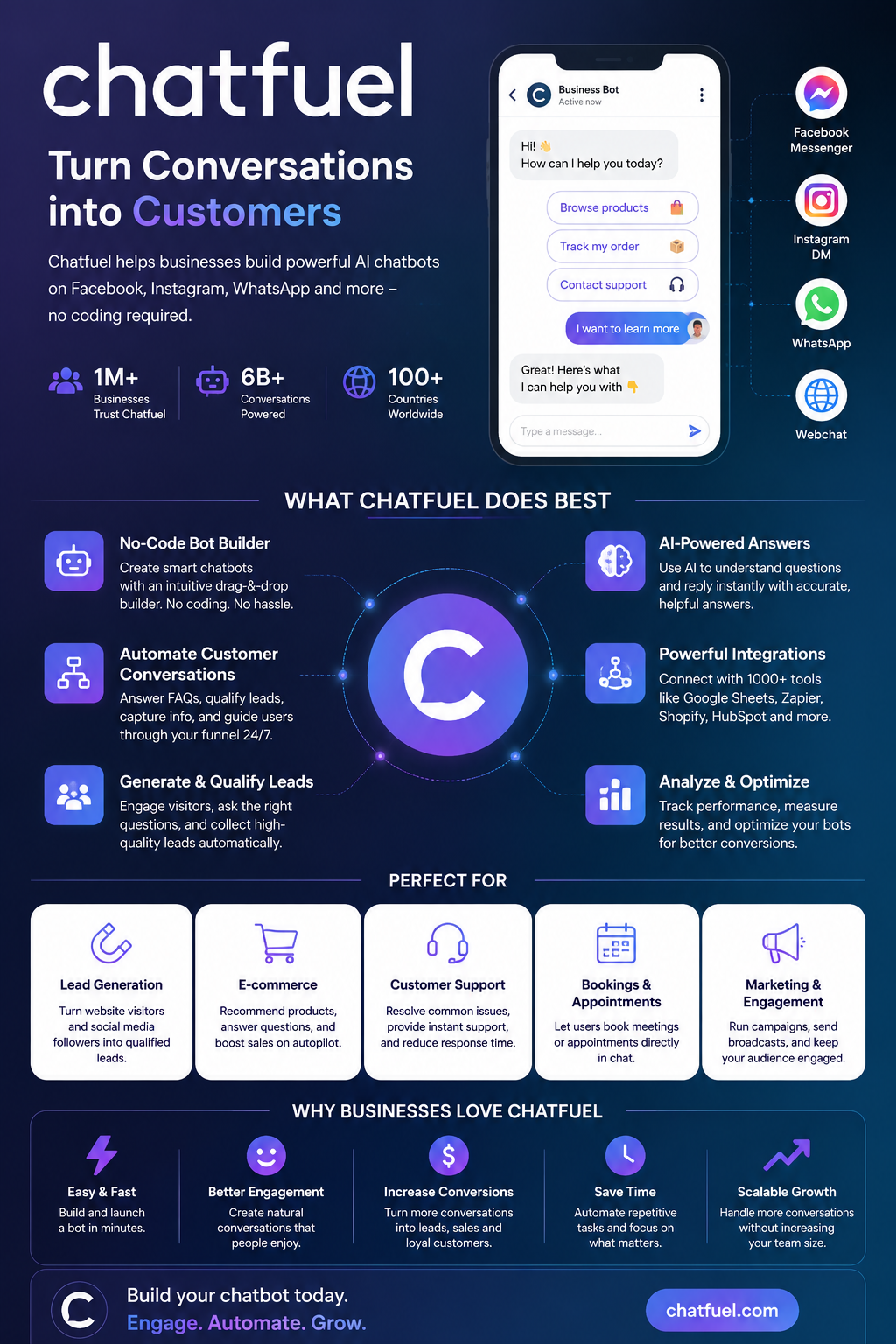
What Chatfuel Bot Builder Does Best
The way businesses communicate with customers has changed dramatically. People no longer expect to wait hours or days for a response to a simple question. They want immediate answers, convenient purchasing experiences, personalized recommendations, and support through the messaging platforms they already use. At the same time, businesses need to handle increasing numbers of conversations without continuously increasing the size of their customer-service and marketing teams.
This is the environment in which Chatfuel's bot-building platform becomes valuable.
Chatfuel is designed around conversational automation: helping businesses create automated interactions with customers across messaging and communication channels. Its strongest use cases center on marketing, lead generation, sales, customer engagement, support, and automated conversations. The platform has historically been particularly associated with Facebook Messenger and Instagram automation and has expanded its capabilities to other channels, including WhatsApp.
The most important thing Chatfuel does well is turn conversations into automated business processes.
It can take a customer interaction that would traditionally require a person—answering a question, qualifying a lead, recommending a product, collecting information, sending a follow-up, or guiding someone toward a purchase—and turn much of that process into an automated conversation.
That makes Chatfuel more than a simple chatbot.
It is better understood as a conversational automation tool that helps businesses engage customers, capture opportunities, and move people toward useful outcomes.
1. Chatfuel excels at no-code chatbot creation
One of Chatfuel's greatest strengths is accessibility.
Building a conversational application from scratch traditionally requires programming knowledge. Developers may need to create the interface, write the conversation logic, connect databases, integrate APIs, manage authentication, test different scenarios, and maintain the application.
Chatfuel removes much of that technical barrier.
Its visual approach allows businesses to design automated conversations without having to write every part of the system from scratch. This is particularly valuable to marketers, small-business owners, ecommerce operators, and customer-service teams that need to create or modify conversational experiences quickly.
The importance of no-code development is not simply that it makes software easier to build.
It changes who gets to build it.
A marketing manager can design a lead-generation flow. A sales team can create a qualification conversation. An ecommerce business can build a product-recommendation experience. A support team can automate frequently asked questions.
Instead of every change becoming a software-development request, business teams can participate directly in designing their customer interactions.
That makes Chatfuel especially effective for organizations that value speed and experimentation.
2. It does particularly well at automating conversations
The basic purpose of a chatbot is to automate communication.
Chatfuel allows businesses to create conversations that can respond to customer inputs, present options, collect information, and guide users toward specific outcomes.
This can be useful for simple questions such as:
«"What are your opening hours?"»
But the real value emerges when conversations become more structured.
A customer might ask about a product.
The bot can provide information.
The customer can indicate their budget.
The bot can suggest an appropriate product.
The customer can ask about delivery.
The bot can provide shipping information.
The customer can decide to purchase.
The bot can direct them toward the relevant next step.
The conversation becomes a miniature customer journey.
This is one of Chatfuel's fundamental strengths: automating multiple steps of an interaction instead of simply answering one question.
3. Lead generation is one of its strongest applications
For many businesses, one of the most valuable uses of Chatfuel is lead generation.
A website visitor, social-media follower, or messaging user represents a potential opportunity. But businesses need information before they can determine whether that person is a serious prospect.
Chatfuel can help automate that qualification process.
Instead of presenting a traditional contact form, a company can initiate a conversation.
For example:
«"What are you interested in?"»
The visitor selects an option.
«"How large is your team?"»
The visitor responds.
«"When are you looking to get started?"»
The visitor chooses a timeframe.
The business now has much more useful information than it might receive from a basic "Contact us" form.
The bot can also request contact information, identify customer preferences, and route qualified prospects toward a salesperson.
This is where conversational automation becomes particularly powerful.
The bot is not merely collecting names and email addresses.
It is qualifying potential customers while the conversation is taking place.
4. Chatfuel is especially good at social-media engagement
One of Chatfuel's defining strengths has been its relationship with social messaging.
Businesses increasingly communicate with customers through platforms such as Instagram, Facebook Messenger, and WhatsApp. This creates an enormous opportunity for conversational automation.
Instead of forcing a customer to leave social media and visit a separate website, businesses can interact with them within the messaging environment.
This can make the customer journey significantly shorter.
For example, a person sees an Instagram post about a product and sends a message asking for more information.
Instead of receiving:
«"Visit our website for details."»
the customer can receive an immediate automated response.
The bot can answer questions, present products, collect information, and potentially guide the person toward a purchase.
This is particularly valuable because the customer's interest is strongest at the moment they initiate the conversation.
Reducing the distance between interest and action is one of Chatfuel's most useful capabilities.
5. It can turn Instagram conversations into business opportunities
Instagram is especially important for businesses that depend on visual marketing.
A customer might discover a product through a post, Reel, advertisement, or influencer recommendation. The next step may be a direct message.
That message is an opportunity.
Chatfuel can help businesses automate responses and create conversational flows around Instagram interactions.
For example, a fashion brand might receive a message asking:
«"How much is this dress?"»
Instead of relying entirely on a human employee to respond, an automated conversation can provide the price and continue with related information.
The customer could then be asked:
«"Would you like to see available sizes?"»
From there, the bot can guide the customer toward additional product information or purchasing options.
The important principle is that the conversation does not have to stop at the first answer.
A well-designed bot can turn a question into a journey.
6. It is powerful for ecommerce
Ecommerce is another area where Chatfuel's conversational approach can be particularly effective.
Online shopping often involves uncertainty.
Customers may ask:
- Which product is right for me?
- What size should I choose?
- Does this item come in another color?
- How long will delivery take?
- Do you ship to my country?
- Can I return it?
- Is this product available?
These questions can become barriers to purchase.
A conversational bot can address those barriers immediately.
Imagine an online clothing store.
A customer begins a conversation and says:
«"I need something for a wedding."»
The bot could ask about gender, style, budget, color preferences, and size.
Instead of forcing the customer to search through hundreds of products, the conversation can narrow the options.
The bot essentially becomes a digital shopping assistant.
This is particularly useful because personalization can improve the shopping experience while reducing the amount of manual assistance required from staff.
7. It can automate repetitive customer support
Customer support teams often spend a large percentage of their time answering the same questions repeatedly.
Examples include:
- Delivery times.
- Return policies.
- Business hours.
- Product availability.
- Pricing.
- Account questions.
- Basic troubleshooting.
- Order-related questions.
A chatbot can handle many of these repetitive interactions.
This gives human agents more time to focus on complicated cases.
The value is not necessarily that the bot replaces the support team.
The better model is that the bot becomes the first layer of support.
Simple problems can be resolved automatically.
More complex problems can be passed to a human.
This creates a scalable support structure:
Automation handles volume.
Humans handle complexity.
That is one of the most practical reasons businesses use chatbot technology.
8. AI makes the conversations more flexible
Traditional bots generally rely on predefined rules.
For example:
User clicks A → show response A.
User clicks B → show response B.
This can be effective for predictable processes, but it becomes restrictive when customers communicate in unexpected ways.
AI changes that.
Instead of requiring customers to use exact phrases, AI-powered chatbot systems can interpret natural-language questions and generate or select appropriate responses.
Chatfuel's more recent positioning incorporates AI-powered customer conversations and automation, reflecting the broader movement from simple scripted bots toward AI agents and assistants.
This allows the system to respond to a wider range of customer requests.
For example, a customer might say:
«"I'm looking for something affordable that can arrive before Friday."»
That sentence contains several pieces of information.
An AI-enabled conversational system can potentially interpret the intent, understand the constraints, and continue the interaction appropriately.
This makes the experience feel more natural than a rigid menu.
9. It combines automation with business rules
AI is powerful, but businesses still need control.
A company cannot simply tell an AI system to "talk to customers" and expect every interaction to follow its policies perfectly.
Businesses need rules.
They may need to determine:
- Which information can be provided.
- Which products can be recommended.
- When discounts can be offered.
- Which customers qualify for certain promotions.
- When a conversation should be escalated.
- What information should be collected.
- Which customers should be routed to sales.
This is where structured chatbot flows remain valuable.
The strongest conversational systems combine AI flexibility with predictable automation.
AI can understand what the customer means.
Business rules can determine what should happen next.
That combination allows Chatfuel-style automation to remain useful while giving businesses greater control over customer journeys.
10. It does well at personalized conversations
Personalization is another major advantage of conversational automation.
Customers are more likely to engage when a conversation is relevant to them.
A bot can ask questions and use the answers to change what happens next.
For example:
A new customer might receive an introduction.
An existing customer might receive support options.
A high-value prospect might be directed toward a sales representative.
A returning shopper might receive product recommendations.
A customer interested in a specific category might receive information about that category.
The conversation becomes dynamic.
Instead of presenting the same information to everyone, the bot can respond to what the individual has already said.
This makes automation feel less like automation.
11. Chatfuel is good at collecting customer information
Data collection is an important part of many business processes.
Companies may need to collect:
- Names.
- Email addresses.
- Phone numbers.
- Product preferences.
- Locations.
- Budgets.
- Appointment preferences.
- Customer requirements.
Traditional forms can accomplish this, but conversational collection can feel more natural.
Instead of asking customers to complete ten fields simultaneously, the bot can collect information gradually.
For example:
«"What's your name?"»
Then:
«"Thanks, John. What product are you interested in?"»
Then:
«"What's your preferred budget?"»
Each question has a purpose.
The customer sees one small task at a time.
This can make the process less intimidating and potentially improve completion rates.
12. It can help businesses follow up automatically
Lead generation is only valuable if businesses follow up.
A company may receive hundreds of inquiries but fail to convert them because prospects are not contacted quickly enough.
Automated messaging can help businesses maintain communication after the initial interaction.
For example:
Customer expresses interest → information collected → follow-up message → reminder → sales conversation.
This can be particularly useful for businesses where customers require time before making a purchase.
A customer may not be ready to buy immediately.
Instead of losing the prospect, automated follow-up can keep the business present during the decision-making process.
The key is to use automation intelligently.
The goal should be useful follow-up rather than sending customers endless promotional messages.
13. It can support appointment and booking workflows
Many businesses depend on appointments.
Examples include:
- Salons.
- Clinics.
- Real-estate agencies.
- Consultants.
- Coaches.
- Restaurants.
- Service businesses.
- Sales teams.
A chatbot can make booking easier.
Instead of navigating through several pages, a customer can simply start a conversation.
The bot can ask what service they need, identify a preferred time, collect contact information, and direct them toward an available appointment.
This can reduce friction.
The easier it is for someone to move from interest to a confirmed appointment, the fewer opportunities are lost along the way.
14. Integrations make the chatbot more useful
A chatbot becomes significantly more valuable when it can communicate with other business systems.
Imagine a bot that collects a customer's information but cannot send it anywhere.
Someone would still have to manually transfer that data into a CRM or spreadsheet.
That defeats much of the purpose of automation.
Integrations solve this problem.
Chatfuel can be connected with external tools and business systems so that information from conversations can become part of larger workflows.
For example:
Chatbot → CRM
Chatbot → Google Sheets
Chatbot → email marketing system
Chatbot → ecommerce platform
Chatbot → notification system
Chatbot → sales workflow
This turns the chatbot into an operational tool rather than simply a communication interface.
15. It can connect marketing and sales
One of the most valuable aspects of conversational automation is its ability to connect marketing activity with sales outcomes.
A marketing campaign might attract thousands of people.
But marketing teams need to know who is actually interested.
A chatbot can help identify that interest.
For example:
Advertisement → chatbot → qualification → lead capture → sales notification
This creates a direct connection between marketing and sales.
The conversation can act as a bridge.
Marketing generates attention.
The chatbot captures intent.
Sales receives qualified opportunities.
That is considerably more valuable than measuring engagement only through likes or clicks.
16. It can improve response speed
Speed is one of the simplest benefits of automation.
A human employee might not respond immediately.
An automated system can.
For common questions, this means customers can receive assistance almost instantly.
This matters because customer expectations are shaped by the speed of modern digital services.
When someone sends a message, they generally expect a response.
Waiting for a business to open or for an employee to become available can create frustration.
A chatbot provides an always-available first response.
Even if a human ultimately needs to intervene, the bot can acknowledge the request and collect relevant information in the meantime.
17. It can operate at scale
One human employee can only handle a limited number of conversations simultaneously.
Automation does not have the same limitation.
A bot can respond to many conversations at once.
This is particularly valuable during periods of high demand.
Imagine a business launching a major promotion.
Thousands of customers may ask similar questions within a short period.
A human-only support model could quickly become overwhelmed.
A chatbot can absorb a significant amount of repetitive demand.
This allows businesses to scale customer engagement without necessarily scaling headcount at exactly the same rate.
18. It helps businesses make social engagement actionable
Social media can generate enormous amounts of attention, but attention alone does not necessarily produce revenue.
Chatfuel helps businesses move from public engagement to private conversation.
Someone comments on a post.
They receive an automated response.
They start a conversation.
The business captures their interest.
The customer receives information.
The conversation can eventually lead toward a purchase or lead capture.
This is powerful because it transforms social media from a broadcasting channel into an interactive sales and customer-service environment.
Instead of simply saying:
"Look at our product."
the business can effectively say:
"Let's talk about what you need."
19. It supports conversational marketing
Traditional marketing often interrupts people with advertisements.
Conversational marketing takes a different approach.
Instead of presenting the customer with a generic message, the business can begin an interaction.
The customer can ask questions.
The business can respond.
The customer can identify their needs.
The system can personalize the experience.
This can make marketing feel more useful.
For example, a travel company might ask:
«"Where would you like to travel?"»
Then:
«"What's your budget?"»
Then:
«"Are you traveling alone or with family?"»
The result could be a personalized recommendation.
The customer is not simply being advertised to.
They are participating in the marketing experience.
That is one of the most compelling applications of chatbot technology.
20. It can reduce friction in the customer journey
Most businesses have friction.
Customers may need to:
- Find a contact page.
- Fill out a form.
- Search through FAQs.
- Wait for a response.
- Navigate multiple pages.
- Repeat information.
- Switch between applications.
Every unnecessary step creates an opportunity for abandonment.
Chatfuel can reduce some of this friction by putting multiple steps inside one conversation.
The customer can ask.
The bot can answer.
The customer can provide information.
The bot can react.
The customer can take the next step.
The journey becomes more continuous.
This is perhaps one of the most important principles behind successful chatbot design:
Make the next useful action obvious and easy.
21. It is useful for small businesses
Large companies often have dedicated marketing, sales, engineering, and customer-service teams.
Small businesses do not always have those resources.
A small business owner might be responsible for marketing, customer support, sales, operations, and administration simultaneously.
Automation can therefore have an o
The way businesses communicate with customers has changed dramatically. People no longer expect to wait hours or days for a response to a simple question. They want immediate answers, convenient purchasing experiences, personalized recommendations, and support through the messaging platforms they already use. At the same time, businesses need to handle increasing numbers of conversations without continuously increasing the size of their customer-service and marketing teams.
This is the environment in which Chatfuel's bot-building platform becomes valuable.
Chatfuel is designed around conversational automation: helping businesses create automated interactions with customers across messaging and communication channels. Its strongest use cases center on marketing, lead generation, sales, customer engagement, support, and automated conversations. The platform has historically been particularly associated with Facebook Messenger and Instagram automation and has expanded its capabilities to other channels, including WhatsApp.
The most important thing Chatfuel does well is turn conversations into automated business processes.
It can take a customer interaction that would traditionally require a person—answering a question, qualifying a lead, recommending a product, collecting information, sending a follow-up, or guiding someone toward a purchase—and turn much of that process into an automated conversation.
That makes Chatfuel more than a simple chatbot.
It is better understood as a conversational automation tool that helps businesses engage customers, capture opportunities, and move people toward useful outcomes.
1. Chatfuel excels at no-code chatbot creation
One of Chatfuel's greatest strengths is accessibility.
Building a conversational application from scratch traditionally requires programming knowledge. Developers may need to create the interface, write the conversation logic, connect databases, integrate APIs, manage authentication, test different scenarios, and maintain the application.
Chatfuel removes much of that technical barrier.
Its visual approach allows businesses to design automated conversations without having to write every part of the system from scratch. This is particularly valuable to marketers, small-business owners, ecommerce operators, and customer-service teams that need to create or modify conversational experiences quickly.
The importance of no-code development is not simply that it makes software easier to build.
It changes who gets to build it.
A marketing manager can design a lead-generation flow. A sales team can create a qualification conversation. An ecommerce business can build a product-recommendation experience. A support team can automate frequently asked questions.
Instead of every change becoming a software-development request, business teams can participate directly in designing their customer interactions.
That makes Chatfuel especially effective for organizations that value speed and experimentation.
2. It does particularly well at automating conversations
The basic purpose of a chatbot is to automate communication.
Chatfuel allows businesses to create conversations that can respond to customer inputs, present options, collect information, and guide users toward specific outcomes.
This can be useful for simple questions such as:
«"What are your opening hours?"»
But the real value emerges when conversations become more structured.
A customer might ask about a product.
The bot can provide information.
The customer can indicate their budget.
The bot can suggest an appropriate product.
The customer can ask about delivery.
The bot can provide shipping information.
The customer can decide to purchase.
The bot can direct them toward the relevant next step.
The conversation becomes a miniature customer journey.
This is one of Chatfuel's fundamental strengths: automating multiple steps of an interaction instead of simply answering one question.
3. Lead generation is one of its strongest applications
For many businesses, one of the most valuable uses of Chatfuel is lead generation.
A website visitor, social-media follower, or messaging user represents a potential opportunity. But businesses need information before they can determine whether that person is a serious prospect.
Chatfuel can help automate that qualification process.
Instead of presenting a traditional contact form, a company can initiate a conversation.
For example:
«"What are you interested in?"»
The visitor selects an option.
«"How large is your team?"»
The visitor responds.
«"When are you looking to get started?"»
The visitor chooses a timeframe.
The business now has much more useful information than it might receive from a basic "Contact us" form.
The bot can also request contact information, identify customer preferences, and route qualified prospects toward a salesperson.
This is where conversational automation becomes particularly powerful.
The bot is not merely collecting names and email addresses.
It is qualifying potential customers while the conversation is taking place.
4. Chatfuel is especially good at social-media engagement
One of Chatfuel's defining strengths has been its relationship with social messaging.
Businesses increasingly communicate with customers through platforms such as Instagram, Facebook Messenger, and WhatsApp. This creates an enormous opportunity for conversational automation.
Instead of forcing a customer to leave social media and visit a separate website, businesses can interact with them within the messaging environment.
This can make the customer journey significantly shorter.
For example, a person sees an Instagram post about a product and sends a message asking for more information.
Instead of receiving:
«"Visit our website for details."»
the customer can receive an immediate automated response.
The bot can answer questions, present products, collect information, and potentially guide the person toward a purchase.
This is particularly valuable because the customer's interest is strongest at the moment they initiate the conversation.
Reducing the distance between interest and action is one of Chatfuel's most useful capabilities.
5. It can turn Instagram conversations into business opportunities
Instagram is especially important for businesses that depend on visual marketing.
A customer might discover a product through a post, Reel, advertisement, or influencer recommendation. The next step may be a direct message.
That message is an opportunity.
Chatfuel can help businesses automate responses and create conversational flows around Instagram interactions.
For example, a fashion brand might receive a message asking:
«"How much is this dress?"»
Instead of relying entirely on a human employee to respond, an automated conversation can provide the price and continue with related information.
The customer could then be asked:
«"Would you like to see available sizes?"»
From there, the bot can guide the customer toward additional product information or purchasing options.
The important principle is that the conversation does not have to stop at the first answer.
A well-designed bot can turn a question into a journey.
6. It is powerful for ecommerce
Ecommerce is another area where Chatfuel's conversational approach can be particularly effective.
Online shopping often involves uncertainty.
Customers may ask:
- Which product is right for me?
- What size should I choose?
- Does this item come in another color?
- How long will delivery take?
- Do you ship to my country?
- Can I return it?
- Is this product available?
These questions can become barriers to purchase.
A conversational bot can address those barriers immediately.
Imagine an online clothing store.
A customer begins a conversation and says:
«"I need something for a wedding."»
The bot could ask about gender, style, budget, color preferences, and size.
Instead of forcing the customer to search through hundreds of products, the conversation can narrow the options.
The bot essentially becomes a digital shopping assistant.
This is particularly useful because personalization can improve the shopping experience while reducing the amount of manual assistance required from staff.
7. It can automate repetitive customer support
Customer support teams often spend a large percentage of their time answering the same questions repeatedly.
Examples include:
- Delivery times.
- Return policies.
- Business hours.
- Product availability.
- Pricing.
- Account questions.
- Basic troubleshooting.
- Order-related questions.
A chatbot can handle many of these repetitive interactions.
This gives human agents more time to focus on complicated cases.
The value is not necessarily that the bot replaces the support team.
The better model is that the bot becomes the first layer of support.
Simple problems can be resolved automatically.
More complex problems can be passed to a human.
This creates a scalable support structure:
Automation handles volume.
Humans handle complexity.
That is one of the most practical reasons businesses use chatbot technology.
8. AI makes the conversations more flexible
Traditional bots generally rely on predefined rules.
For example:
User clicks A → show response A.
User clicks B → show response B.
This can be effective for predictable processes, but it becomes restrictive when customers communicate in unexpected ways.
AI changes that.
Instead of requiring customers to use exact phrases, AI-powered chatbot systems can interpret natural-language questions and generate or select appropriate responses.
Chatfuel's more recent positioning incorporates AI-powered customer conversations and automation, reflecting the broader movement from simple scripted bots toward AI agents and assistants.
This allows the system to respond to a wider range of customer requests.
For example, a customer might say:
«"I'm looking for something affordable that can arrive before Friday."»
That sentence contains several pieces of information.
An AI-enabled conversational system can potentially interpret the intent, understand the constraints, and continue the interaction appropriately.
This makes the experience feel more natural than a rigid menu.
9. It combines automation with business rules
AI is powerful, but businesses still need control.
A company cannot simply tell an AI system to "talk to customers" and expect every interaction to follow its policies perfectly.
Businesses need rules.
They may need to determine:
- Which information can be provided.
- Which products can be recommended.
- When discounts can be offered.
- Which customers qualify for certain promotions.
- When a conversation should be escalated.
- What information should be collected.
- Which customers should be routed to sales.
This is where structured chatbot flows remain valuable.
The strongest conversational systems combine AI flexibility with predictable automation.
AI can understand what the customer means.
Business rules can determine what should happen next.
That combination allows Chatfuel-style automation to remain useful while giving businesses greater control over customer journeys.
10. It does well at personalized conversations
Personalization is another major advantage of conversational automation.
Customers are more likely to engage when a conversation is relevant to them.
A bot can ask questions and use the answers to change what happens next.
For example:
A new customer might receive an introduction.
An existing customer might receive support options.
A high-value prospect might be directed toward a sales representative.
A returning shopper might receive product recommendations.
A customer interested in a specific category might receive information about that category.
The conversation becomes dynamic.
Instead of presenting the same information to everyone, the bot can respond to what the individual has already said.
This makes automation feel less like automation.
11. Chatfuel is good at collecting customer information
Data collection is an important part of many business processes.
Companies may need to collect:
- Names.
- Email addresses.
- Phone numbers.
- Product preferences.
- Locations.
- Budgets.
- Appointment preferences.
- Customer requirements.
Traditional forms can accomplish this, but conversational collection can feel more natural.
Instead of asking customers to complete ten fields simultaneously, the bot can collect information gradually.
For example:
«"What's your name?"»
Then:
«"Thanks, John. What product are you interested in?"»
Then:
«"What's your preferred budget?"»
Each question has a purpose.
The customer sees one small task at a time.
This can make the process less intimidating and potentially improve completion rates.
12. It can help businesses follow up automatically
Lead generation is only valuable if businesses follow up.
A company may receive hundreds of inquiries but fail to convert them because prospects are not contacted quickly enough.
Automated messaging can help businesses maintain communication after the initial interaction.
For example:
Customer expresses interest → information collected → follow-up message → reminder → sales conversation.
This can be particularly useful for businesses where customers require time before making a purchase.
A customer may not be ready to buy immediately.
Instead of losing the prospect, automated follow-up can keep the business present during the decision-making process.
The key is to use automation intelligently.
The goal should be useful follow-up rather than sending customers endless promotional messages.
13. It can support appointment and booking workflows
Many businesses depend on appointments.
Examples include:
- Salons.
- Clinics.
- Real-estate agencies.
- Consultants.
- Coaches.
- Restaurants.
- Service businesses.
- Sales teams.
A chatbot can make booking easier.
Instead of navigating through several pages, a customer can simply start a conversation.
The bot can ask what service they need, identify a preferred time, collect contact information, and direct them toward an available appointment.
This can reduce friction.
The easier it is for someone to move from interest to a confirmed appointment, the fewer opportunities are lost along the way.
14. Integrations make the chatbot more useful
A chatbot becomes significantly more valuable when it can communicate with other business systems.
Imagine a bot that collects a customer's information but cannot send it anywhere.
Someone would still have to manually transfer that data into a CRM or spreadsheet.
That defeats much of the purpose of automation.
Integrations solve this problem.
Chatfuel can be connected with external tools and business systems so that information from conversations can become part of larger workflows.
For example:
Chatbot → CRM
Chatbot → Google Sheets
Chatbot → email marketing system
Chatbot → ecommerce platform
Chatbot → notification system
Chatbot → sales workflow
This turns the chatbot into an operational tool rather than simply a communication interface.
15. It can connect marketing and sales
One of the most valuable aspects of conversational automation is its ability to connect marketing activity with sales outcomes.
A marketing campaign might attract thousands of people.
But marketing teams need to know who is actually interested.
A chatbot can help identify that interest.
For example:
Advertisement → chatbot → qualification → lead capture → sales notification
This creates a direct connection between marketing and sales.
The conversation can act as a bridge.
Marketing generates attention.
The chatbot captures intent.
Sales receives qualified opportunities.
That is considerably more valuable than measuring engagement only through likes or clicks.
16. It can improve response speed
Speed is one of the simplest benefits of automation.
A human employee might not respond immediately.
An automated system can.
For common questions, this means customers can receive assistance almost instantly.
This matters because customer expectations are shaped by the speed of modern digital services.
When someone sends a message, they generally expect a response.
Waiting for a business to open or for an employee to become available can create frustration.
A chatbot provides an always-available first response.
Even if a human ultimately needs to intervene, the bot can acknowledge the request and collect relevant information in the meantime.
17. It can operate at scale
One human employee can only handle a limited number of conversations simultaneously.
Automation does not have the same limitation.
A bot can respond to many conversations at once.
This is particularly valuable during periods of high demand.
Imagine a business launching a major promotion.
Thousands of customers may ask similar questions within a short period.
A human-only support model could quickly become overwhelmed.
A chatbot can absorb a significant amount of repetitive demand.
This allows businesses to scale customer engagement without necessarily scaling headcount at exactly the same rate.
18. It helps businesses make social engagement actionable
Social media can generate enormous amounts of attention, but attention alone does not necessarily produce revenue.
Chatfuel helps businesses move from public engagement to private conversation.
Someone comments on a post.
They receive an automated response.
They start a conversation.
The business captures their interest.
The customer receives information.
The conversation can eventually lead toward a purchase or lead capture.
This is powerful because it transforms social media from a broadcasting channel into an interactive sales and customer-service environment.
Instead of simply saying:
"Look at our product."
the business can effectively say:
"Let's talk about what you need."
19. It supports conversational marketing
Traditional marketing often interrupts people with advertisements.
Conversational marketing takes a different approach.
Instead of presenting the customer with a generic message, the business can begin an interaction.
The customer can ask questions.
The business can respond.
The customer can identify their needs.
The system can personalize the experience.
This can make marketing feel more useful.
For example, a travel company might ask:
«"Where would you like to travel?"»
Then:
«"What's your budget?"»
Then:
«"Are you traveling alone or with family?"»
The result could be a personalized recommendation.
The customer is not simply being advertised to.
They are participating in the marketing experience.
That is one of the most compelling applications of chatbot technology.
20. It can reduce friction in the customer journey
Most businesses have friction.
Customers may need to:
- Find a contact page.
- Fill out a form.
- Search through FAQs.
- Wait for a response.
- Navigate multiple pages.
- Repeat information.
- Switch between applications.
Every unnecessary step creates an opportunity for abandonment.
Chatfuel can reduce some of this friction by putting multiple steps inside one conversation.
The customer can ask.
The bot can answer.
The customer can provide information.
The bot can react.
The customer can take the next step.
The journey becomes more continuous.
This is perhaps one of the most important principles behind successful chatbot design:
Make the next useful action obvious and easy.
21. It is useful for small businesses
Large companies often have dedicated marketing, sales, engineering, and customer-service teams.
Small businesses do not always have those resources.
A small business owner might be responsible for marketing, customer support, sales, operations, and administration simultaneously.
Automation can therefore have an o