Anna Julia Cooper: Born Enslaved, She Became a Scholar and Educator
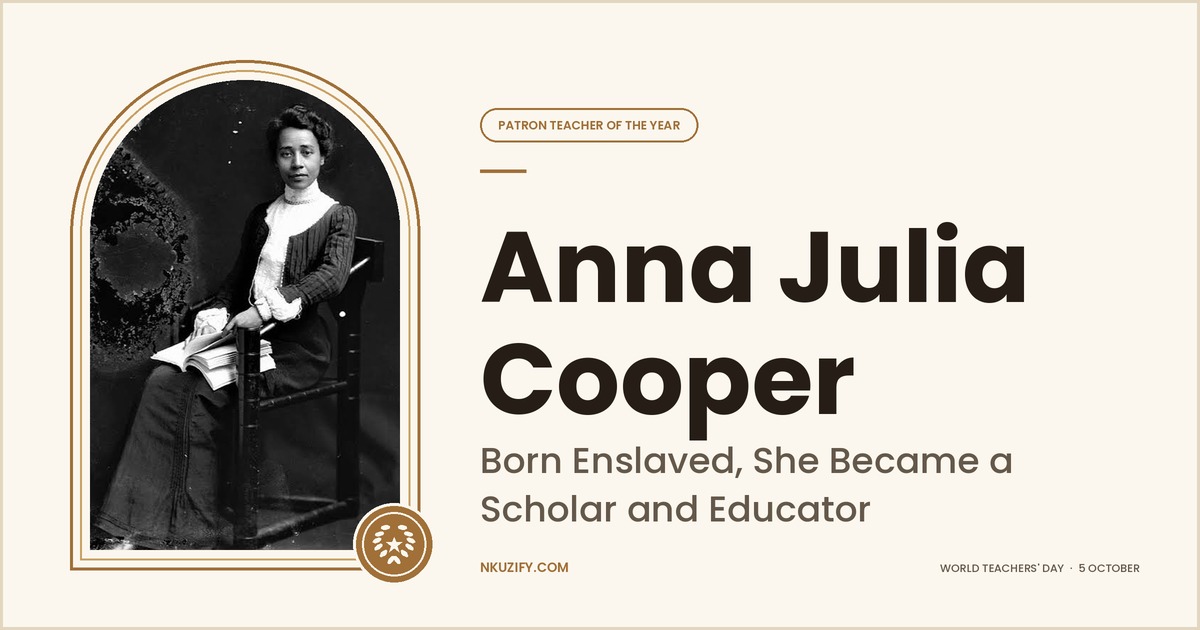
Recognised by Nkuzify as Patron Teacher of the Year.
World Teachers' Day
Happy Teachers' Day from all of us at Nkuzify.
At the age of 65, when most people have long since stopped, Anna Julia Cooper stood before the examiners at the Sorbonne in Paris to defend a thesis on how France had treated the question of slavery.
She knew the subject personally. She had been born into slavery in Raleigh, North Carolina, in 1858.
In the years between, she had taught for decades and written a book that is still read today. She had also adopted five children and supported them by teaching.
A scholarship at nine
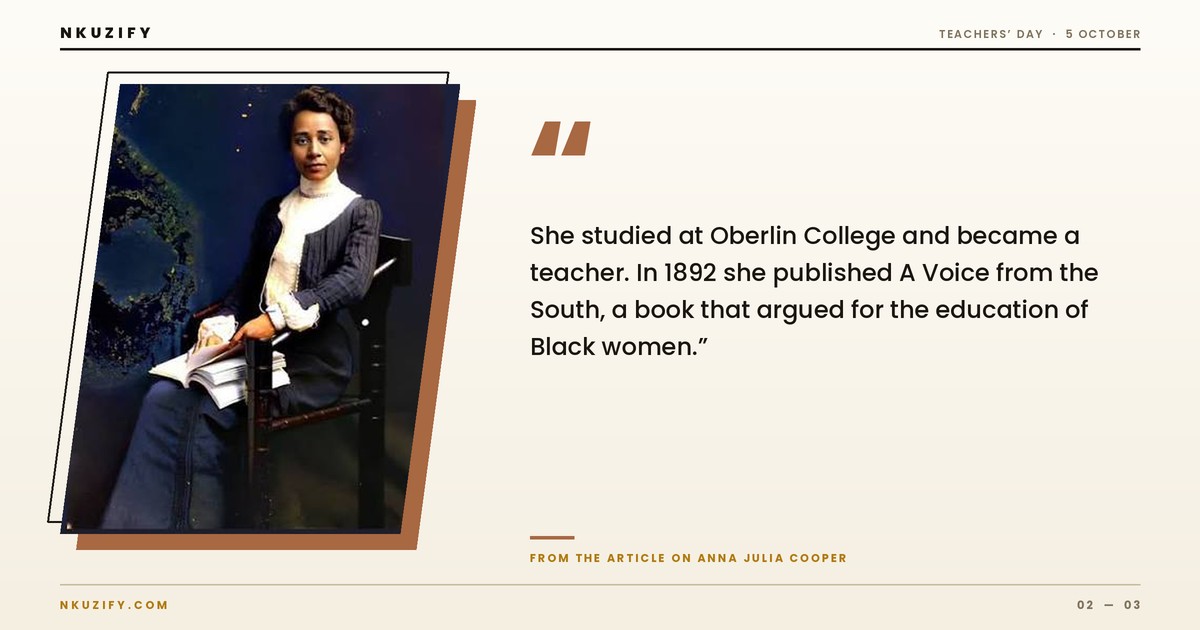
After emancipation, in 1868, the nine-year-old girl entered St Augustine's Normal School and Collegiate Institute in Raleigh, which had been opened to train teachers for the formerly enslaved. She won a scholarship, excelled in mathematics, science, languages and literature, and insisted on following the course of study meant for men.
She married George Cooper in 1877 and was widowed two years later, at 21. She then went to Oberlin College in Ohio, where she earned a bachelor's degree in 1884 and a master's in mathematics in 1888.
The principal who would not lower the bar
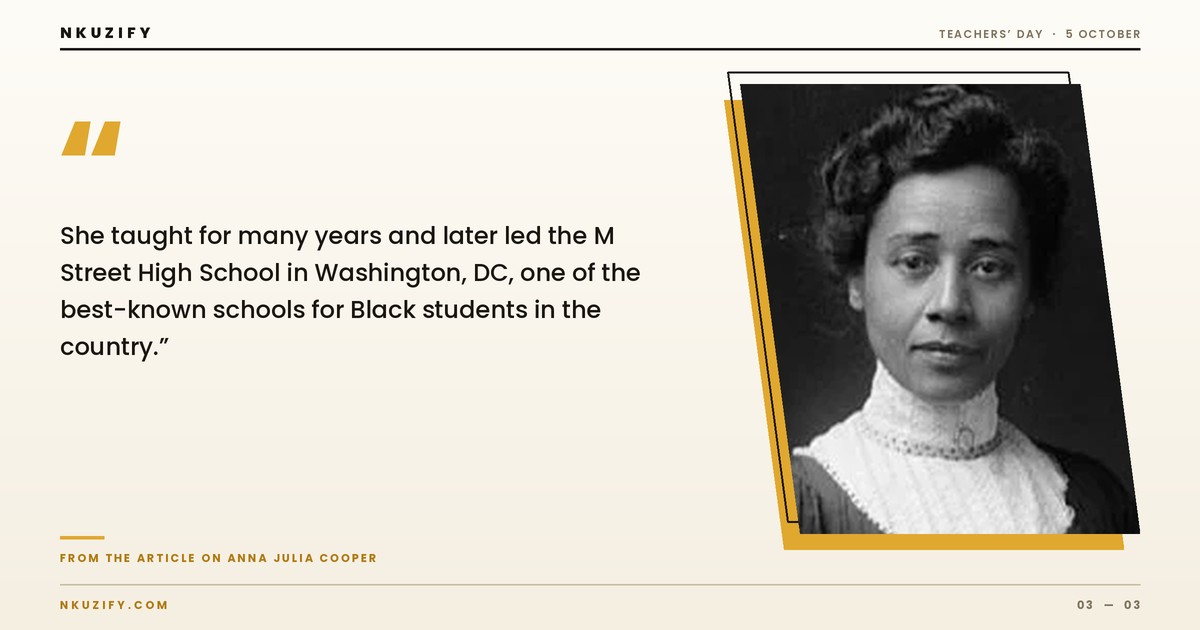
In 1887 she moved to Washington, DC, to teach mathematics and science at the Preparatory High School for Colored Youth, later known as the M Street School and today as Dunbar High School. She became its principal in 1901. Officials wanted Black students limited to vocational training. She insisted on a rigorous college preparatory course, and her students went on to elite universities.
A dispute over that approach cost her the principal's post, but she returned to the school in 1910 and taught Latin there for the next twenty years, until 1930.
A Voice from the South
In 1892 she published A Voice from the South, her only book. It argued for the education of Black women and for the view that their perspective is essential to understanding race and gender in America, an idea that took nearly a century to reach the mainstream. It is considered one of the first works of Black feminist thought.
The doctorate she would not give up
She began doctoral work at Columbia University in 1914. She kept studying while working, and when she moved to the Sorbonne she had to start again, because they would not accept her Columbia credits. She defended her thesis in 1924 (some sources say 1925) and became the fourth African American woman to earn a doctorate.
From 1930 to 1941 she was president of Frelinghuysen University, a school for working adults that she ran from her own home in Washington. She died in 1964, at the age of 105.
Why Nkuzify celebrates her
Cooper refused to let anyone decide in advance what a student could become. She taught the classics to children who had been told they were only fit for trades, and she kept learning herself until she was past 65. That is the spirit of Nkuzify: teach people the full thing, and trust that they can master it.
Read more in Global Patrons of Teaching, or make a free Thank You card for your own teacher.
Comments (0)