Septima Clark: The Teacher Who Taught Ordinary People to Read and Vote
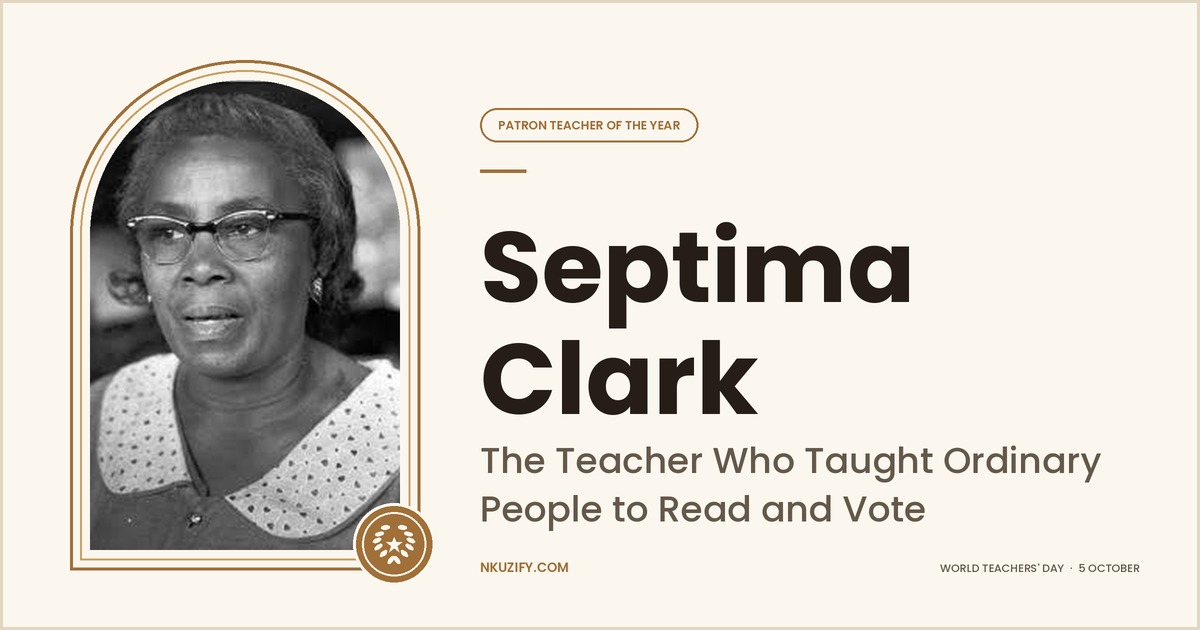
Recognised by Nkuzify as Patron Teacher of the Year.
World Teachers' Day
Happy Teachers' Day from all of us at Nkuzify.
In 1956, after forty years in the classroom, Septima Clark was told to choose between her job and her membership of the NAACP.
She refused to give up the NAACP. Charleston fired her, along with forty-one others, and took away her pension.
She did not stop teaching. She simply moved to classrooms that no school board controlled. Her name was Septima Poinsette Clark.
A girl in a class of a hundred
She was born in 1898 in Charleston, South Carolina. When she started school at five, her mother saw that her class had a hundred pupils for one teacher. She finished at Avery Normal Institute in 1916 with the qualifications to teach, but Charleston schools did not hire Black teachers, so at eighteen she went to Johns Island to teach the children there. Over the next four decades she taught in Charleston, Columbia, McClellanville and North Carolina.
The firing
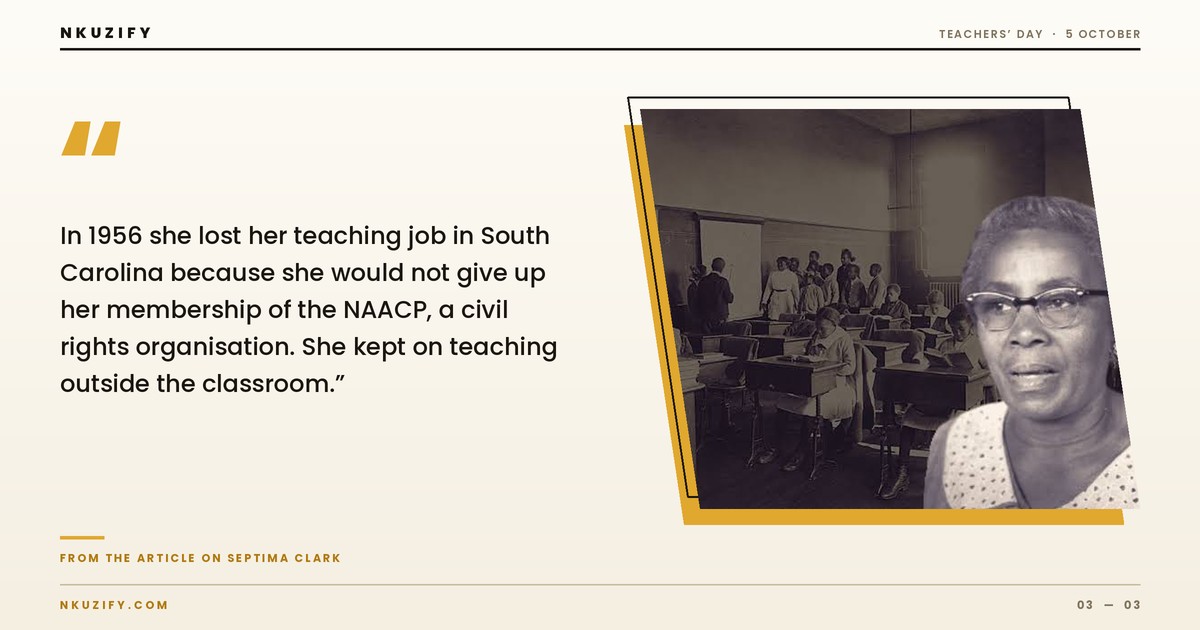
In 1956 the state barred public employees from belonging to civil rights groups, and Charleston's school board fired Clark for her open membership of the NAACP. Some of her colleagues got their jobs back. She did not, and she left Charleston.
The citizenship schools
Highlander Folk School in Tennessee hired her full-time. There she met Esau Jenkins, a bus driver from Johns Island and one of her former pupils, who used his bus rides to teach working people to read. Together with her cousin Bernice Robinson, they built the citizenship schools to teach Black adults to read, to register to vote and to act as citizens.
The first citizenship school opened in 1957 on Johns Island, in two back rooms behind a grocery store run by the Progressive Club. It worked because Clark started with what people needed: a driver wanted to read the questions on the voting form, so that was the first lesson. By 1961 there were thirty-seven such schools across the Sea Islands and the mainland nearby.
From two back rooms to a movement
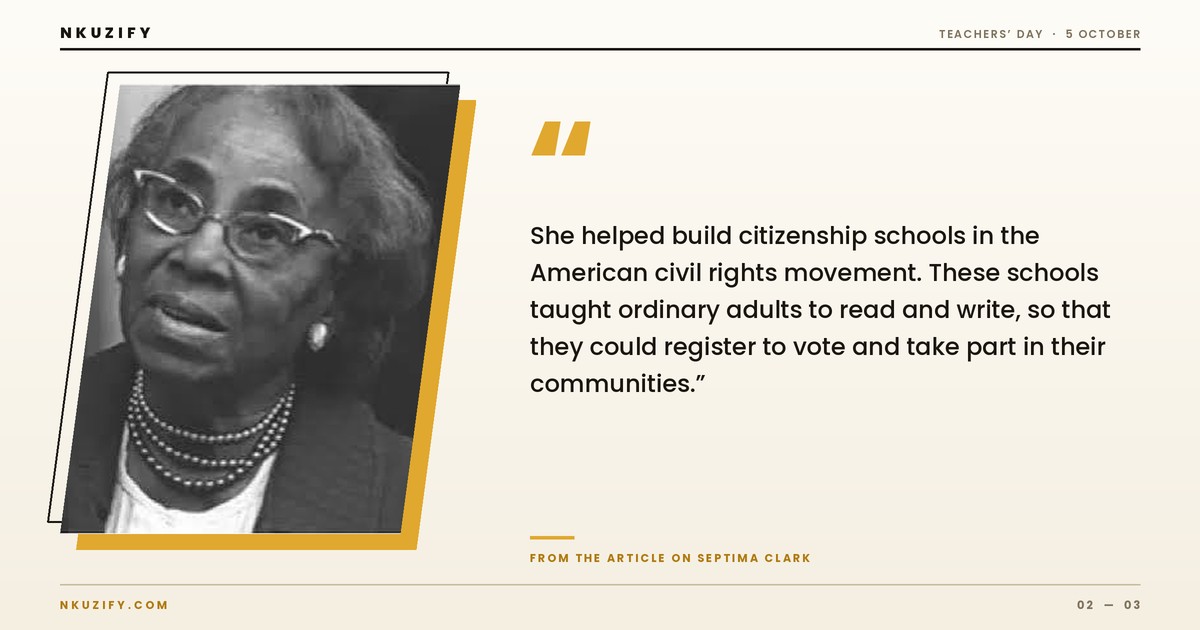
After a raid closed Highlander in 1959, the Southern Christian Leadership Conference took on the citizenship schools and made Clark one of its chief organisers. She travelled across the Deep South training teachers, and hundreds of thousands of Black Americans registered to vote. Andrew Young, who worked beside her, said the schools laid the foundation for what followed. She retired in 1970, moved back to Charleston, and died in 1987.
Why Nkuzify celebrates her
Clark believed that ordinary adults, handed a pen and a patient teacher, could become citizens. She taught people to read in the very rooms where reading had been kept from them. That faith in the learner is what Nkuzify means by teaching anyone anything.
Read more in Global Patrons of Teaching, or make a free Thank You card for your own teacher.
Comments (0)