Be Nna Gi as the First Altar: An Ọdịnani Teaching on Ancestral Return
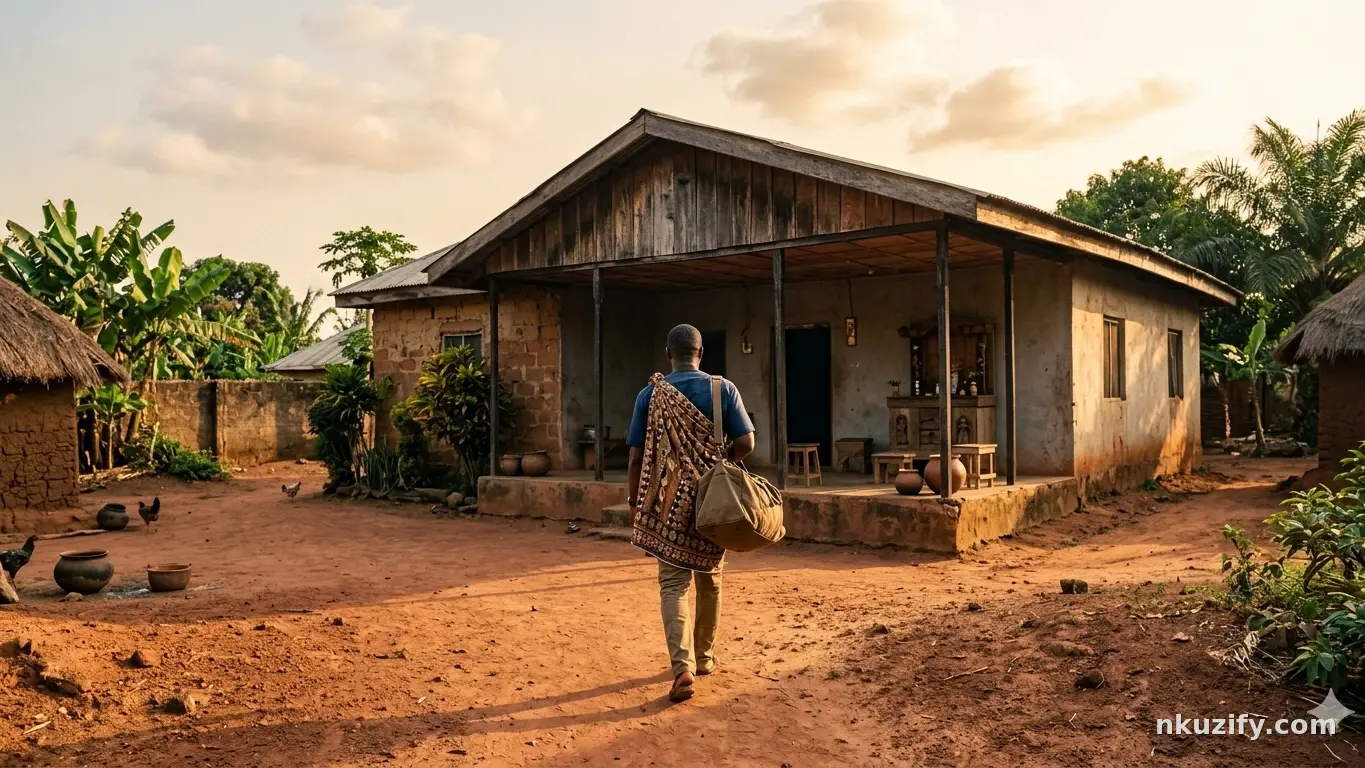
In the understanding of Ọdịnani, a person is not a floating spirit. You are rooted — rooted in soil, lineage, covenant, and memory. When people become spiritually blocked, it is often not because power is absent, but because connection is broken. The first place that connection begins is ụlọ nna — the father’s house, the ancestral home.
The Father’s House as a Living Portal
In Ọdịnani, the ancestral compound is not merely land or buildings. It is an energetic field where:
- the footprints of ancestors remain,
- oaths and blessings were first spoken,
- Chi and lineage forces recognize your identity.
The soil itself carries memory. When one stands barefoot on that ground, it is an act of recognition: “I know where I come from.” Spirit responds strongly to recognition because identity activates alignment.
Many modern spiritual disturbances come from uprootedness — physically distant, mentally disconnected, spiritually uncertain. Returning to one’s ancestral soil symbolically restores the circuit.
Fear as a Spiritual Strategy
My teaching touches a deep reality: fear can become a barrier to redemption. In Ọdịnani terms, fear weakens ikenga consciousness — the courage and will that moves destiny forward. People hear:
- “Don’t go home, they will poison you.”
- “Your village is dangerous.”
- “Your father’s people are your enemies.”
Sometimes these fears come from genuine social issues, but spiritually they may also function as disconnection narratives — stories that sever a person from their source of restoration. When fear becomes the dominant story, the person abandons the very place where healing may begin.
Bare Feet on the Soil — Symbolism of Humility
Removing slippers and standing on ancestral ground represents:
- humility before one’s roots,
- surrender of ego,
- direct grounding between body and Ani (the earth force).
Ani is witness to lineage truth. The earth does not lie. When you stand on it consciously, you are saying: “I return not as a stranger, but as a child of this soil.” This act alone can restore inner stability because the spirit recognizes belonging.
Ọjị (Kola Nut) as Communication
Holding ọjị and calling the ancestors is not magic for spectacle; it is protocol. In Ọdịnani:
- Ọjị opens speech.
- Speech opens relationship.
- Relationship opens response.
Calling ancestors at the father’s house acknowledges hierarchy — living descendants speaking to spiritual elders. The “answer” may come through dreams, clarity, emotional release, or sudden direction, not necessarily dramatic visions.
Redemption Begins with Alignment, Not Escape
A core principle in Ọdịnani is that healing comes from alignment, not avoidance.
- You do not run from your origin to find destiny.
- You reconcile with origin so destiny flows properly.
This does not mean ignoring genuine human conflicts or danger. Wisdom (amamihe) remains essential. But spiritually, one must distinguish between real danger and inherited fear.
The First Responders of the Spirit
Before distant spirits answer, lineage often answers first because:
- they know your name,
- they share your blood covenant,
- their unfinished prayers may continue through you.
Your father’s house becomes a first respondent because it is where your personal spiritual history began.
The Healing Lesson
From an Ọdịnani perspective, the deeper teaching is:
- Healing requires returning to source.
- Fear must be examined, not obeyed blindly.
- Ancestors respond when acknowledged with respect and sincerity.
- Reconnection restores direction.
Sometimes the journey home is not just physical travel — it can also be an inner reconciliation with lineage, forgiveness, and acceptance of one’s origins.
In Ọdịnani wisdom:
The tree that forgets its roots fears every wind.
The tree that remembers its roots stands firm.
Returning to nna gi is not about glorifying the past; it is about reactivating the foundation from which spiritual balance rises.
Ezeakonobi Arọh
Ọdịnani Library
Written 17 February 2026
Comments (0)