The Concept of Oma Agwụ
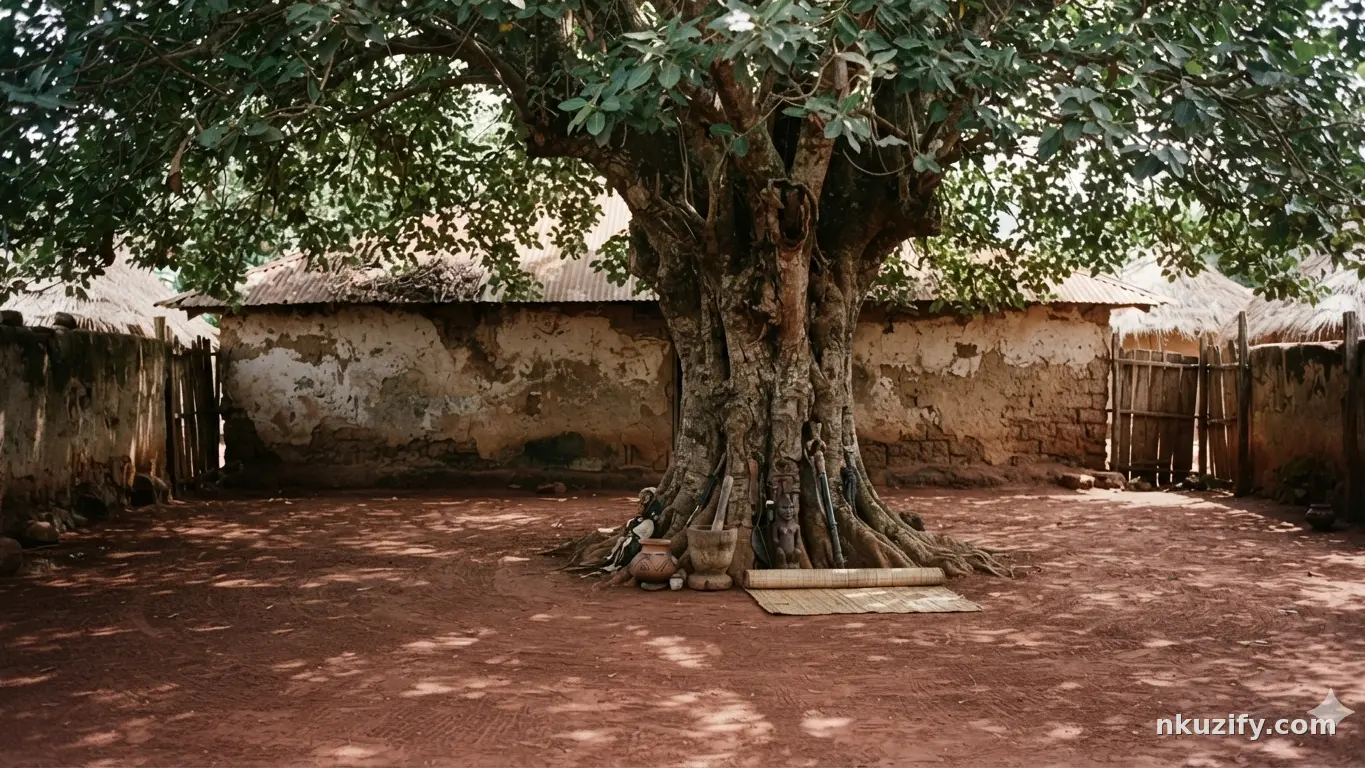
Oma Agwụ is a sacred location (Okwu Mmụọ / Holy Place / Shrine), ebe ana amatụ Agwụ onye Dibia, where ilu Agwụ was performed. It is a holy ground where different ancient Agwụ forces are installed, each positioned with respectful distance from one another according to spiritual order and balance.
This place is not merely physical land; it is a spiritual point of alignment between the individual, ancestors, and cosmic intelligence. It represents the grounding of one’s spiritual calling into earth reality.
What Exists at the Oma Agwụ
At the Oma Agwụ, different manifestations of Agwụ may be installed, such as:
- Uru Agwụ
- Agwụ (main Ezumezu force)
- Udo Agwụ
- Ekwensu Agwụ…. Etc.
Each serves a different spiritual purpose and must never be confused with another.
Agwụ Ezumezu
Agwụ Ezumezu is the complete gathering of gifts, talents, spiritual knowledge, and abilities bestowed by Alụsị for helping and saving lives. This Agwụ is not singular; it is a conglomerate of:
- Personal Agwụ (Agwụ chi)
- Ancestral Agwụ from the father’s lineage (Agwụ ngwulu be Nna gi / Agwụ ndị Ichie)
- Maternal lineage influences (Agwụ ikwu Nne gi)
- Extended maternal ancestries (ikwu nne nne, ikwu nne Nna)
- Ikwu Chi, especially for one called as a Dibia
Thus, Agwụ represents an accumulated spiritual inheritance and responsibility.
Imatụ Agwụ and the Call of the Dibia
Every human being has Agwụ, but not everyone is called to serve publicly as a Dibia.
- Some people express their Agwụ for personal growth only.
- Some need only appeasement.
- Others must appease, install, and walk fully in their life path.
For one truly called to public spiritual service, Imatụ Agwụ becomes necessary and compulsory. The process establishes spiritual stability and alignment with destiny. The direction for installation and work should always come through Afa, which reveals what follows the person personally and ancestrally.
Uru Agwụ — The Shadow Agent
Uru Agwụ follows the main Agwụ and is usually installed on the left side, not far from it. This is the nseke agency — the shadow agent of Agwụ. Key characteristics:
- Fed differently and not appeased like the main Agwụ
- Functions as a protective boundary
- Prevents akagholi from trespassing into one’s Agwụ or sanity
- Acts both as spoiler and firewall when properly managed
Spiritually, Uru also represents inherited family traits that must be mastered. It reflects:
- Past errors
- Repeated patterns
- Weaknesses that must be transformed into strength
Some families are known for specific recurring negative patterns — these are understood as Uru di na Agwụ ndị Ichie, requiring spiritual awareness and correction.
Uru Agwụ is not ọgwụ that is used to fight battles as many often thought. You can’t use it against your enemies, it’s not ajọọ ọgwụ bikonu.
Ekwensu Agwụ — Distinct from Uru Agwụ
Ekwensu Agwụ is not Uru Agwụ. It is a separate installation representing:
- Transactional intelligence
- Strategic navigation
- Trickery used wisely to overcome obstacles
- A powerful protective intelligence
Like Uru, it can act as a fire wall, but its energy is oriented toward strategy and survival intelligence rather than shadow correction. Depending on Afa directives, a person may install:
- Ekwensu Agwụ
- Udo Agwụ (Agwụ Udo)
Ekwensu Agwụ or Udo Agwụ is high tension. Ichikọ ya with your Ezumezu Agwụ, ọga etipụ gi ara; may cause madness. Many after imatụ Agwụ fall sick, constant headache, trauma, suffer severe pains due to installing Ekwensu Agwụ or Udo Agwụ with Ezumezu Agwụ together. This installation may take up to four days and must align with ancestral instructions and personal destiny.
Oku Agwụ — Temporary Medium
Oku Agwụ exists for those who do not yet have land to perform full Imatụ Agwụ. It is a temporary arrangement where:
- Agwụ is settled through anyanwụ (isetụọ Agwụ na oku)
- Ọfọ Agwụ is used to feed Agwụ through the oku medium
- The arrangement remains pending until proper land is available
Oku is therefore a transitional spiritual housing — not a replacement for permanent earth installation.
Okuku — Added Stamina and Power
Okuku is additional spiritual strength, power, and stamina created alongside Agwụ. Important principles:
- There is no Okuku without existing Agwụ.
- Ilu Agwụ must occur before Okuku.
- Okuku is not by personal desire (okuku abụghị onye chọọ).
- It is demanded by Agwụ, onye uwa, and permitted by chi.
Thus, Okuku is a spiritual upgrade initiated by destiny, not personal ambition.
Oku vs Okuku
Though similar in sound, they are completely different:
- Oku → temporary medium for feeding Agwụ
- Okuku → added spiritual power after established Agwụ
Confusing these two leads to spiritual error.
Location of Oma Agwụ
Oma Agwụ is not located at a Dibia’s shrine. It must be rooted in:
- One’s ancestral land
- Father’s house
- Personal house connected to lineage
This establishes continuity between land, bloodline, and spirit.
Special Cases
- Young single women often use Oku temporarily, since marriage may relocate their permanent spiritual grounding.
- A married woman performs Dibia work through her own Ezumezu, not her husband’s Agwụ ndị Ichie.
- Through marriage and childbirth, she becomes spiritually acknowledged within her husband’s lineage, opening portals that may influence future reincarnation paths.
Adopted People and Agwụ Installation
For adopted individuals, caution is necessary. Afa consultation is compulsory because:
- Bloodline origin influences Agwụ location.
- Installations done solely within adoptive lineage have sometimes caused instability.
- In some cases, Agwụ had to be removed and reinstalled in ancestral lands of origin.
This emphasizes that Agwụ follows spiritual ancestry, not just social placement.
Agwụ Ndị Ichie and Ana Ndị Ichie
Agwụ ndị Ichie is installed together with:
- Ana ndị Ichie
- Idotu ndị Ichie
- Idotu Agwụ ndị Ichie
These go together as a unified ancestral grounding, linking the living practitioner with ancestral authority and continuity.
Deeper Spiritual Insight
Oma Agwụ represents more than a shrine:
- It is a map of personal destiny.
- It balances light and shadow.
- It aligns inherited energies with present responsibility.
- It transforms ancestral patterns into conscious power.
Agwụ is not merely possession of gifts — it is stewardship of intelligence meant for service, healing, and preservation of life.
Ezeakonobi Arọh
Ọdịnani Library
Written 17 February 2026
Comments (0)